4. Match the Machine to the Work
4.1 For Auto Repair and Tire Shops
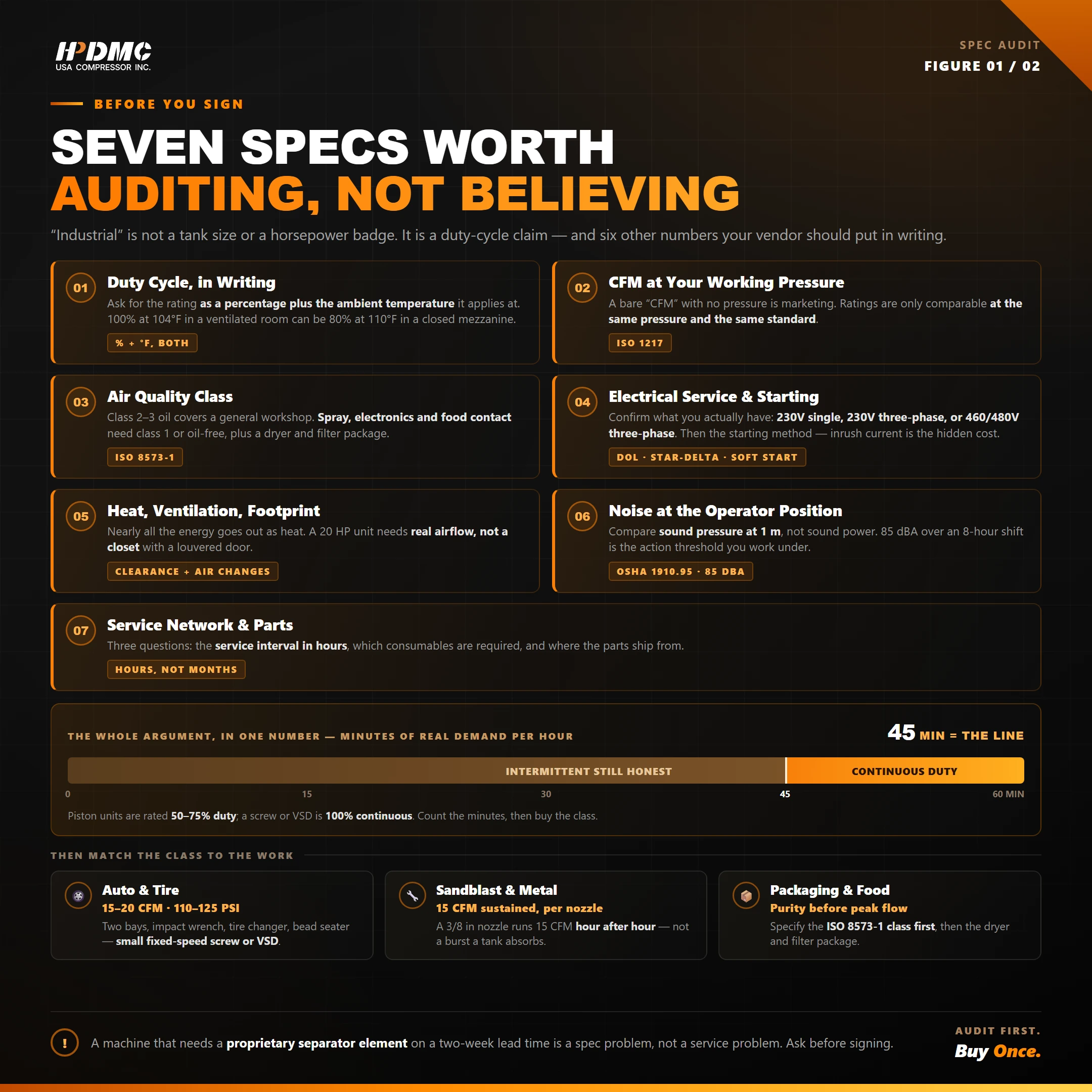
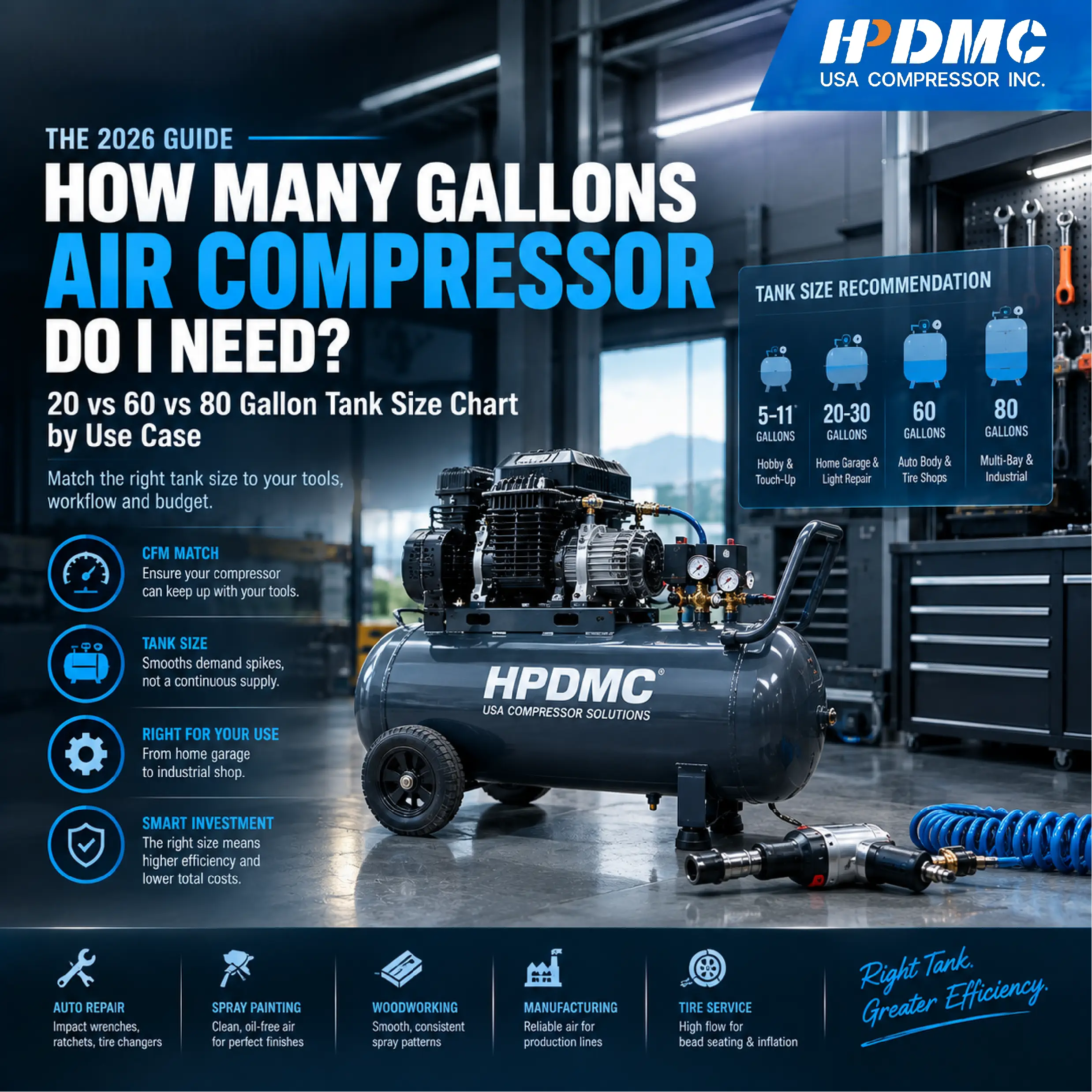
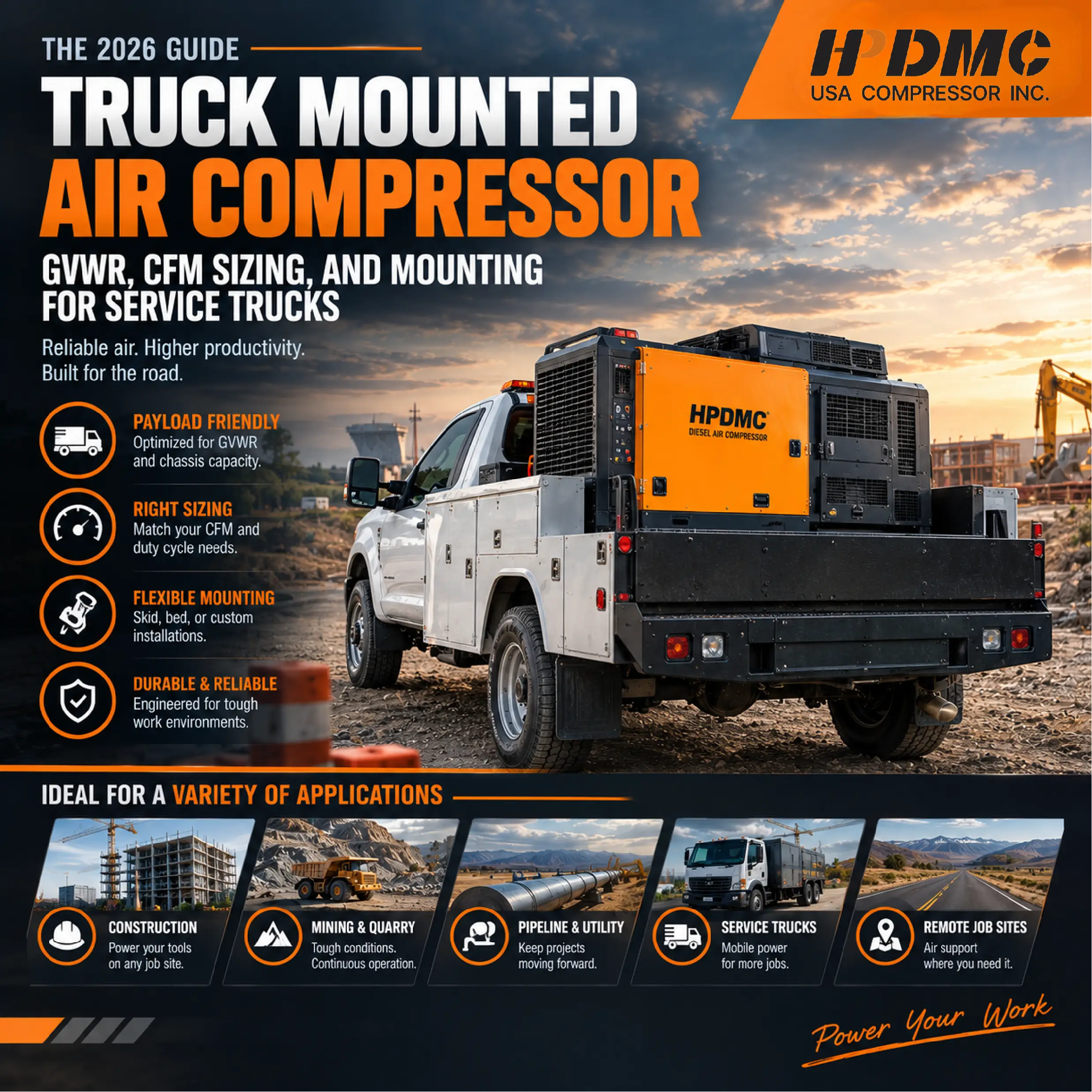
🛞 Two bays with an impact wrench, tire changer, and bead seater: about 15–20 CFM at 110–125 PSI. An industrial air compressor machine in that class — a small fixed-speed screw or a VSD unit — covers it with headroom, runs quiet enough to talk over, and delivers the continuous duty a busy Saturday demands. The mistake here is buying piston capacity by tank size and then discovering the machine cannot keep up when both bays work at once. If the work travels rather than staying in one bay, a truck mounted or portable unit in the same flow class is the practical answer.
4.2 For Sandblasting, Fabrication, and Metalwork
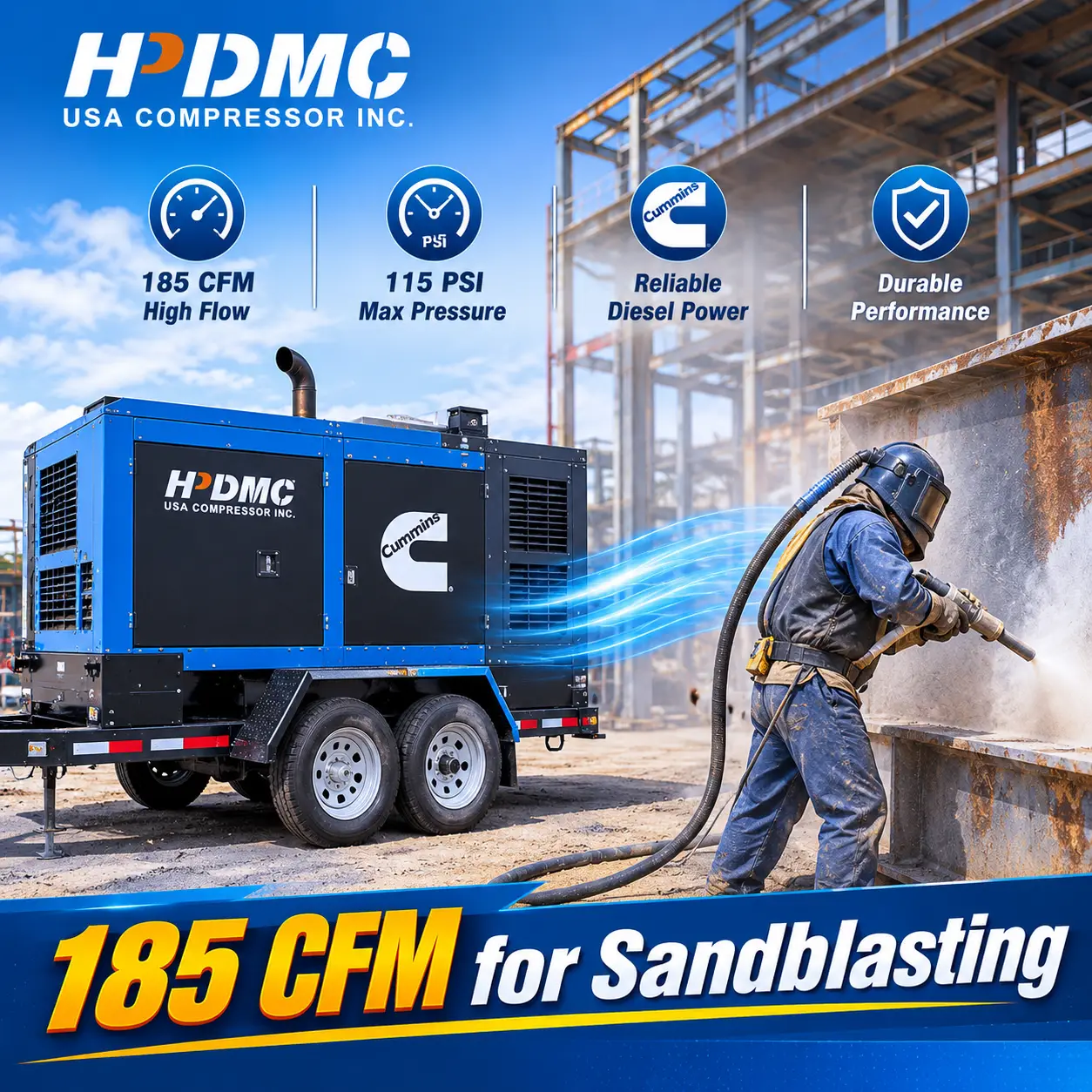
🔧 Sandblasting is the demand profile that breaks undersized machines: a 3/8-inch nozzle can pull 15 CFM continuously, hour after hour. That is not a burst a tank can absorb — it is a sustained load the pump must carry. Size to the nozzle, add 25% for piping and filter losses, and choose a continuous-duty screw machine. If the work is intermittent blasting between other jobs, a VSD machine recovers the energy during the gaps instead of loading and unloading a fixed-speed unit.
4.3 For Packaging, Food, and Clean Processes
📦 Pneumatic packaging, filling, and conveying lines care more about air purity and pressure stability than about peak flow. Specify the ISO 8573-1 class first, then the dryer and filter package, then the machine. A machine with a tight pressure band protects film sealing and pick-and-place accuracy; a machine that swings 15 PSI between load and unload will show up as rejects on the line, not as a compressor problem.
5. Three Industrial Machines, Three Duty Profiles
5.1 Entry Into Continuous Duty — 10 HP
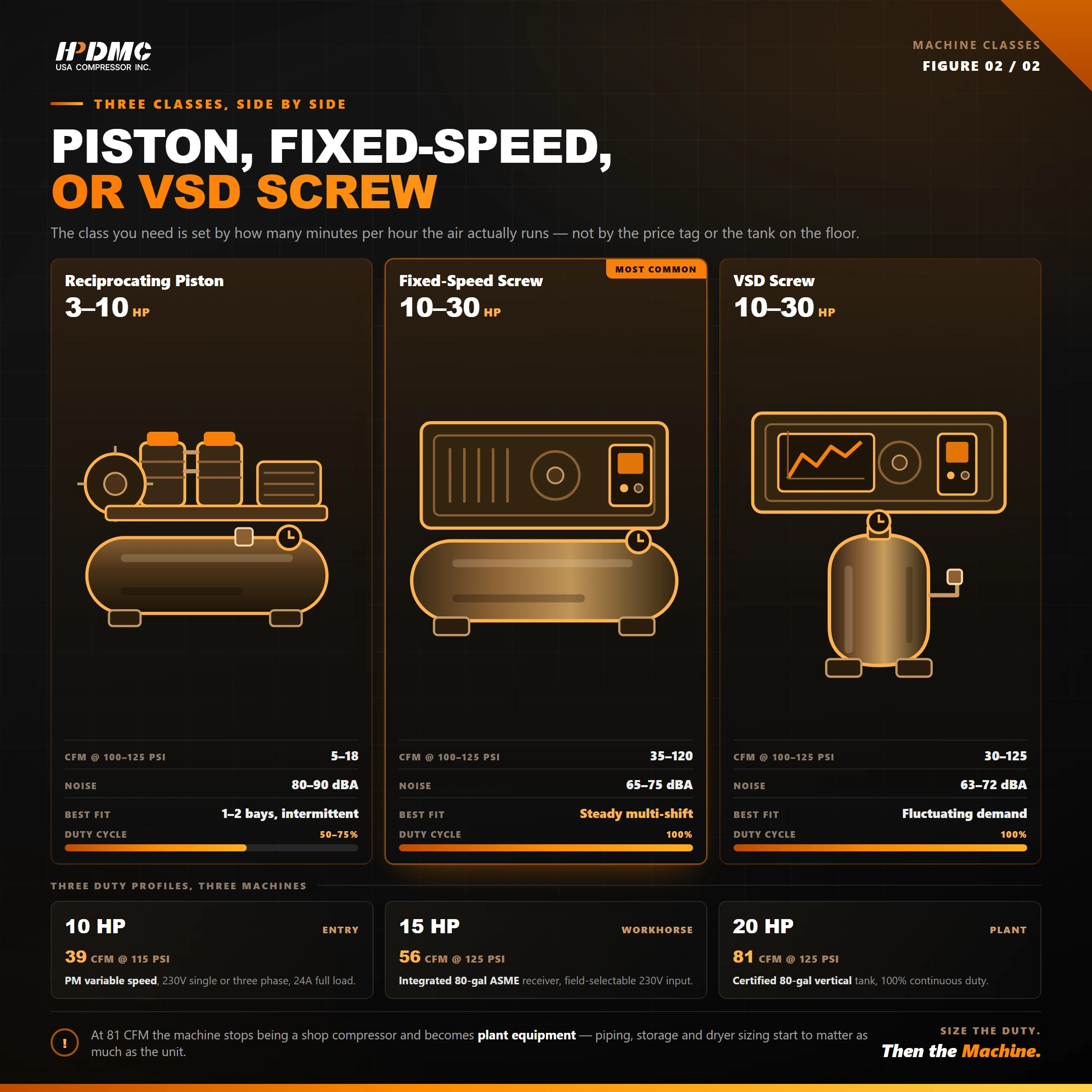
PM VFD Rotary Screw Air Compressor 10HP 39CFM 115PSI — LGJBP-DV7V — permanent-magnet variable-speed drive, 39 CFM at 115 PSI, 230V single or three phase, 24A full load. This is the honest entry point into a continuous-duty industrial machine for a shop that currently runs a piston unit: it delivers screw-class duty and VSD energy savings without stepping into a 20 HP electrical service. Flow and pressure are documented on the spec sheet rather than implied.
5.2 Two-Bay and Fabrication Workhorse — 15 HP
PM VFD All-In-One Rotary Screw System 15HP 56CFM 125PSI — LGJBP-DV11TAV — 56 CFM at 125 PSI, integrated 80-gallon ASME receiver, field-selectable 230V single or three-phase input, 100% continuous duty. The all-in-one format removes the separate receiver, dryer, and piping decisions that most first-time industrial buyers get wrong, and the 56 CFM rating covers two bays plus a sandblasting cabinet with margin.
5.3 Multi-Bay and High-Demand Plant — 20 HP
PM VFD All-In-One Rotary Screw System 20HP 81CFM 125PSI — LGJBP-DV15TAV — 81 CFM at 125 PSI on a certified 80-gallon vertical ASME tank, 100% continuous duty, single or three-phase 230V. At this flow the machine stops being a shop compressor and starts being plant equipment: it carries three or four simultaneous users, tolerates long sandblasting runs, and the VSD keeps pressure stable across the whole distribution system instead of cycling between setpoints. Confirm your service capacity before ordering — this is the level where electrical work becomes part of the project.
6. Installation and Commissioning: What the Price Does Not Cover
6.1 Before the Machine Lands
An industrial air compressor machine is not a plug-and-play purchase. Before delivery, confirm four things: a level pad or floor that can carry the loaded weight without vibration transfer, a ventilation path that meets the clearance in the manual, an automatic condensate drain routed to a legal discharge point, and a dedicated circuit sized to the full-load amps on the nameplate — not to the typical running amps. We have seen more installations fail on the drain and the breaker than on the compressor itself.
6.2 The First 100 Hours Decide the Next 40,000
Commissioning is where machine life is set. Verify rotation direction before loading, record full-load amp draw against nameplate and log it, set the pressure band to your tool requirement rather than the factory default, and perform a first oil and separator change near the 100-hour mark. Then leak-test the distribution with an ultrasonic detector: a plant-wide leak survey typically finds 20–30% of generated air escaping, and fixing those leaks costs far less than the next size up in compressor.
7. Questions Buyers Ask Us Before Signing
Is a 100% duty cycle machine safe to run unattended?
Run continuously, yes; run unattended, no. Duty cycle rates the machine's thermal design, not its safety. Every industrial compressor still needs a functioning pressure switch, relief valve, and automatic condensate drain, and those fail silently. We recommend a daily drain check and a weekly inspection regardless of rating.
Do I really need three-phase power?
⚠️ Not necessarily. Machines with field-selectable single-phase or three-phase input let a shop without three-phase service run industrial-class equipment. What you cannot do is convert one to the other with an external phase converter after purchase — that voids most warranties and derates the motor. Decide the supply first, then buy the matching configuration.
How much does an industrial machine actually save over a piston unit?
📏 The comparison people are usually making is energy per CFM, and it is the wrong comparison if the piston unit cannot run the duty profile at all — a machine that cannot keep up has an infinite cost per delivered CFM. Where the loads are comparable, screw machines with VSD typically reduce energy use in the 30–50% range on fluctuating demand, and heat recovery can offset more. Ask for a load profile first; a savings percentage without your duty profile is a guess.
What maintenance interval should I plan for?
Plan on oil and separator changes by hour interval rather than by calendar, air filter inspection at the same time, and an annual cooler clean. On a three-shift machine that usually means a service event every few months, so parts availability matters as much as the interval itself. Build the interval into your maintenance calendar before the machine lands.
Can one industrial machine serve several buildings or a whole plant?
It can, but piping design becomes the constraint. Every 10 PSI of avoidable pressure drop is roughly 5% of compressor energy, so long runs, undersized headers, and dirty filters cost more than the machine choice usually does. If the distribution network is more than a few hundred feet, get the piping audited before you specify a larger machine to compensate.
Not Sure Which Industrial Machine Actually Fits Your Plant?
Send us your duty profile — hours per shift, tools or processes, required PSI, air quality class, and available electrical service. An HPDMC application engineer will audit the seven specs against your actual work and tell you which machine class and size fits, including when the answer is a smaller machine than you expected.
🛒 Request a Spec Audit · 🔗 Browse Industrial Machines
✔ Seven specs, not a sales sheet · ✔ ASME-certified receivers · ✔ Honest sizing — even a smaller machine