⚡Free Shipping: Ultra-Quiet Portable Oil-Free Air Compressor AWR800-18LM2
Need Help Choosing the Right Compressor?
Need Help Choosing the Right Compressor?
⚡Free Shipping: Ultra-Quiet Portable Oil-Free Air Compressor AWR800-18LM2
Need Help Choosing the Right Compressor?
⚡Free Shipping: Ultra-Quiet Portable Oil-Free Air Compressor AWR800-18LM2

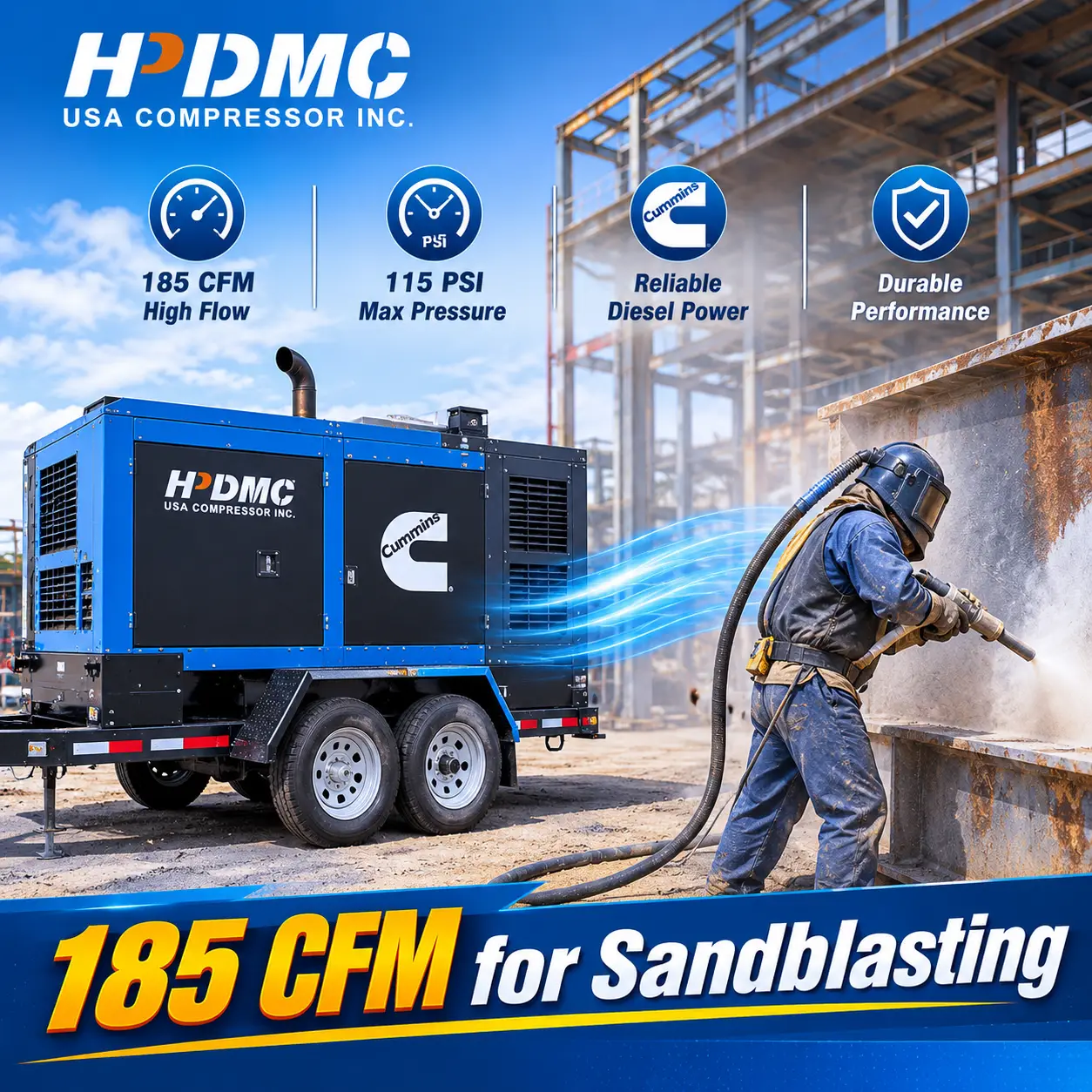
185 CFM Air Compressor for Sandblasting Nozzle Size, PSI & Sizing Guide
Choosing an air compressor for sandblasting is not simply about selecting the largest CFM rating available. The compressor must deliver enough airflow at the required operating pressure to keep the blasting nozzle working consistently.
For contractors, fabrication shops, and industrial blasting operations, a 185 CFM air compressor can be a suitable option for certain abrasive blasting setups. However, whether it is the right choice depends on nozzle size, blasting pressure, hose length, operating conditions, and how continuously the equipment will run.
In this guide, we'll explain how to evaluate a 185 CFM compressor for sandblasting, estimate nozzle airflow requirements, understand pressure losses, and determine what specifications to confirm before purchasing.
📖 If you're comparing industrial equipment, you can also explore HPDMC's 185 CFM diesel screw air compressor solutions to discuss a configuration based on your actual application.
1. What Does 185 CFM Mean for Sandblasting?
CFM stands for cubic feet per minute. It measures the volume of air a compressor can deliver over time.
In abrasive blasting, compressed air accelerates abrasive media through a blasting nozzle. The nozzle's airflow demand determines how much air the compressor must supply.
A 185 CFM compressor is designed for applications requiring substantially more airflow than typical small workshop compressors. It may be considered for mobile blasting operations, industrial surface preparation, and selected contractor projects.
⚠️ However, a compressor's advertised CFM rating should never be evaluated without its corresponding operating pressure.
Before selecting equipment, confirm:
● Delivered airflow at the required operating PSI
● Whether the airflow rating is measured at the compressor outlet or under another specified test condition
● Whether the compressor can sustain the required duty cycle
● Pressure losses through hoses, fittings, filters, and other components
💡 Important: A compressor rated at 185 CFM is not automatically capable of delivering 185 CFM at every pressure setting. Always request the performance data for the specific operating point.
2. Is 185 CFM Enough for Sandblasting?
The answer depends primarily on the blasting nozzle.
A larger nozzle generally consumes more compressed air. As the nozzle wears, its effective opening can also increase, raising airflow demand and potentially reducing blasting performance.
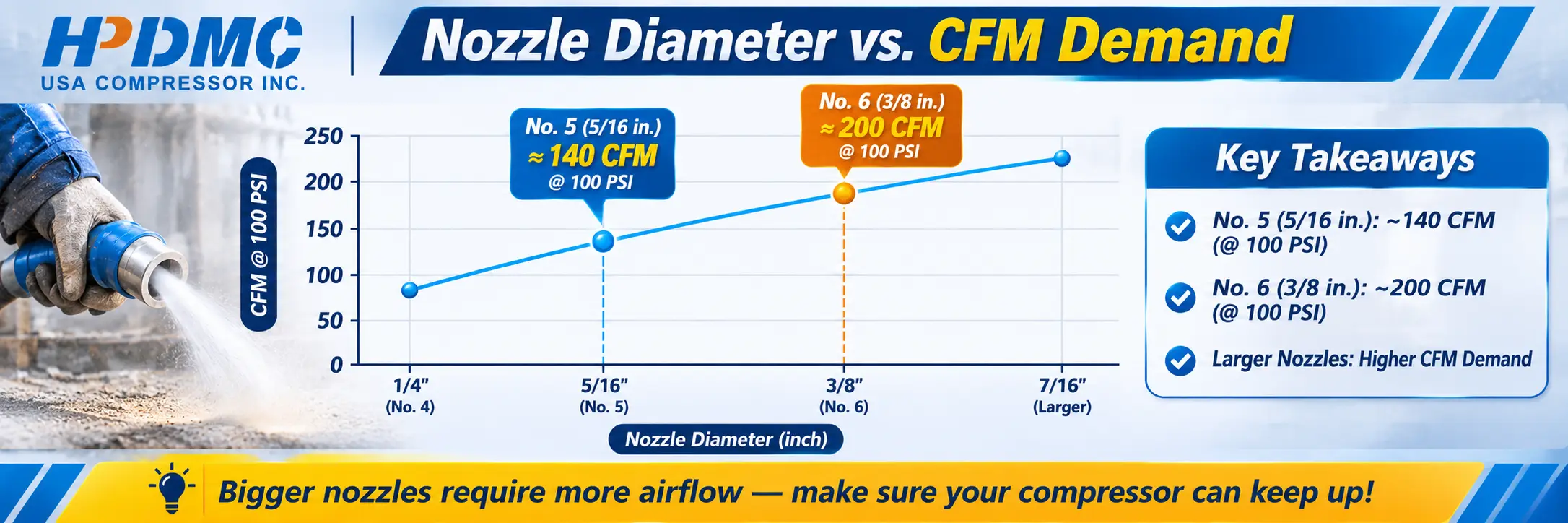
📌 Reference: Published manufacturer guidance illustrates how quickly nozzle demand increases with size. Sullair's blasting guidance gives approximately 140 CFM for a No. 5 nozzle and approximately 200 CFM for a No. 6 nozzle at 100 PSI. Actual requirements vary with nozzle design and operating conditions.
This means a 185 CFM compressor may be worth evaluating for a No. 5 nozzle setup, but it should not be assumed to support every No. 6 configuration at the same pressure.
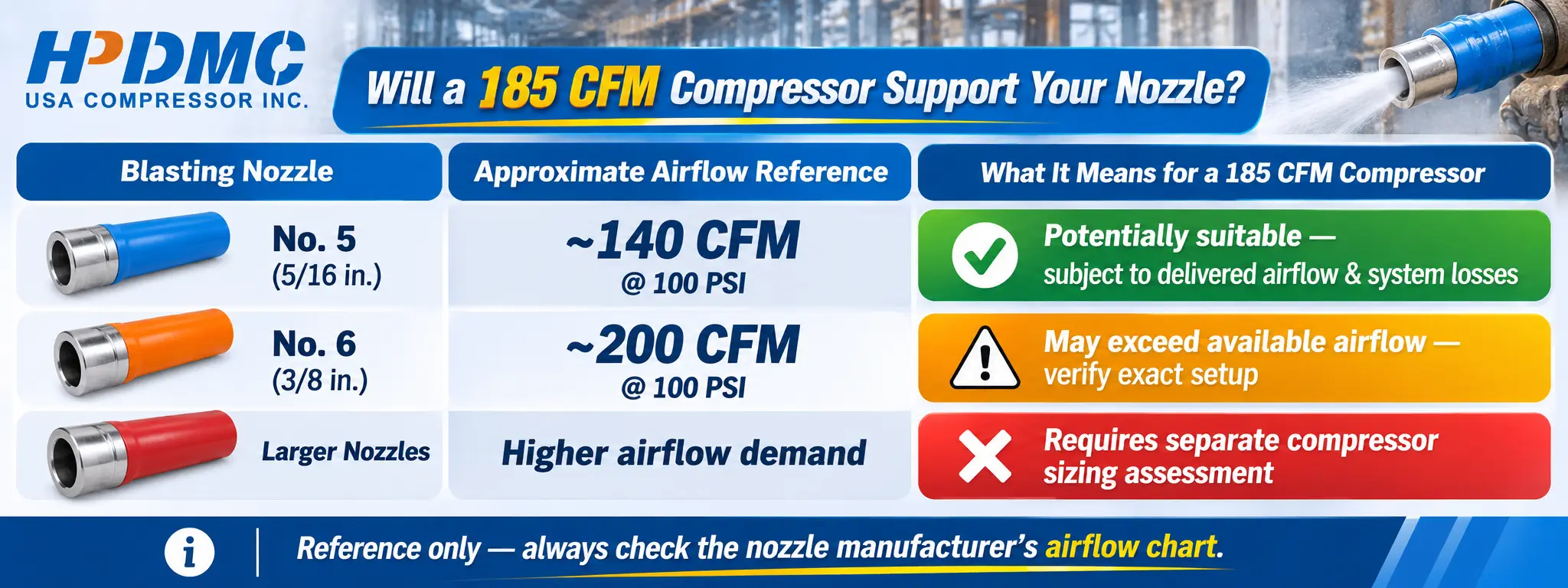
⚠️ These figures are reference points, not universal specifications. Check the nozzle manufacturer's airflow chart for the exact nozzle and pressure combination.
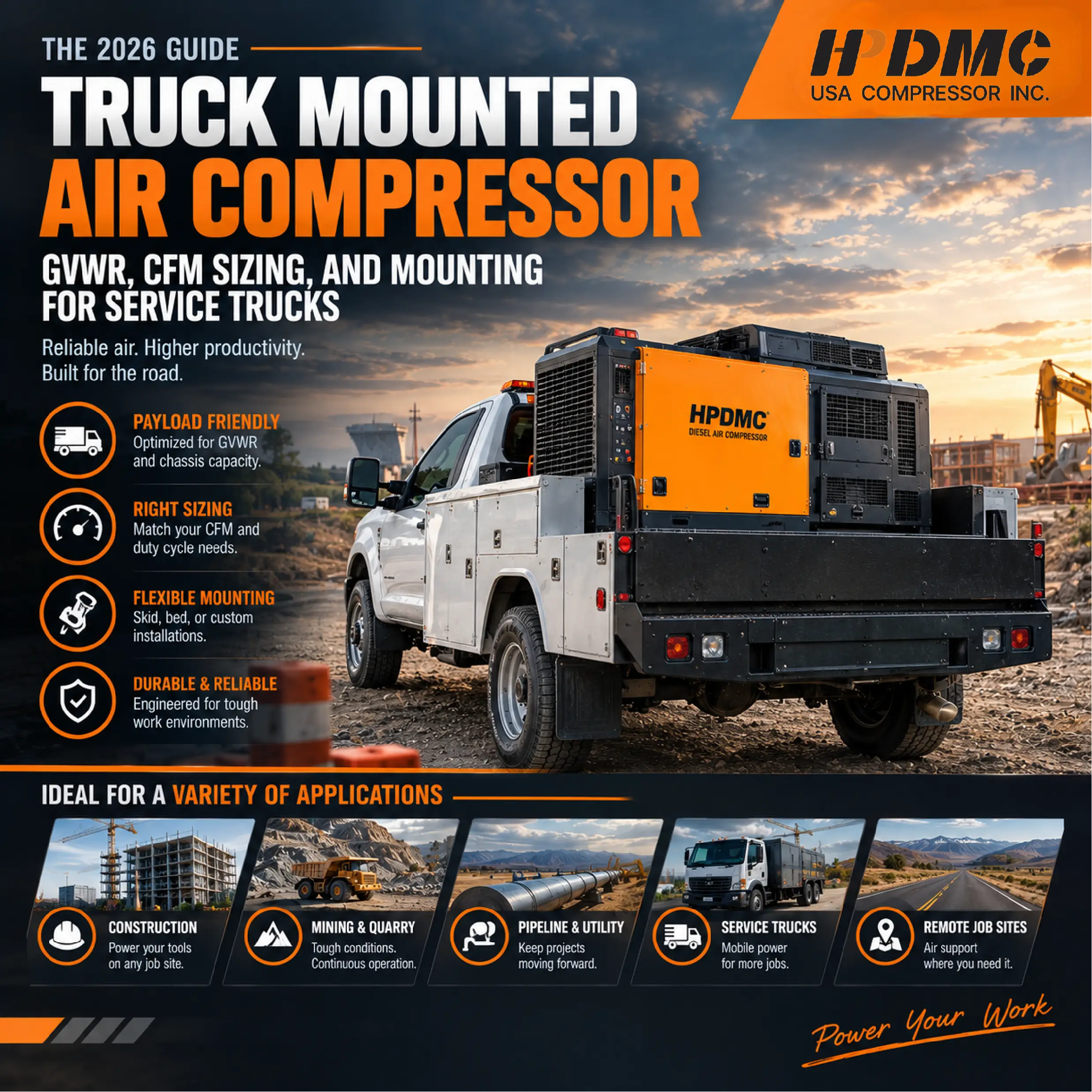
📖 For a more detailed understanding of industrial compressor capacity and application requirements, see our guide to truck-mounted air compressor sizing and applications.
3. How Nozzle Size Affects Sandblasting CFM Requirements
Nozzle size is one of the most important factors when choosing a sandblasting compressor.
A larger nozzle allows more compressed air to pass through it. This can increase abrasive velocity and productivity, but it also increases the compressor's airflow demand.
Three factors should be considered together:
📏 Nozzle Diameter
The nozzle opening directly affects air consumption. Even a small increase in diameter can create a significant increase in required CFM.
⚠️ Do not select a compressor based only on the nozzle's nominal size. Check the manufacturer's airflow chart.
🎚️ Operating Pressure
Sandblasting performance depends on maintaining sufficient pressure at the nozzle, not simply at the compressor outlet.
A long air hose, restrictive fittings, undersized piping, or additional equipment can create pressure losses between the compressor and blasting nozzle.
🔄 Nozzle Wear
A worn nozzle may have a larger opening than its original specification. This can increase air consumption without the operator realizing it.
Regular nozzle inspection and replacement help maintain predictable airflow demand and blasting performance.
Need Help Selecting a Compressor for Your Blasting Project?
Explore high-output compressor configurations for demanding industrial and mobile applications.
185 CFM Diesel Screw Air Compressor Solutions4. What PSI Do You Need for Sandblasting?
Many abrasive blasting applications operate around 90–100 PSI at the nozzle, although the correct pressure depends on the blasting equipment, abrasive material, surface condition, and application.
⚠️ A compressor's maximum PSI rating is not the same as its usable operating pressure.
For example, a system may have a compressor capable of producing a certain outlet pressure, but pressure can decrease as air travels through hoses, couplings, moisture separators, and other components.
When evaluating a 185 CFM compressor, confirm:
● Required nozzle pressure
● Compressor operating pressure at the required airflow
● Pressure drop across the air delivery system
● Hose diameter and total hose length
● Whether multiple air-consuming devices operate simultaneously
💡 A properly sized system should maintain the required pressure and airflow during the actual blasting process.
5. How to Size a Compressor for Abrasive Blasting
Choosing the right compressor involves more than matching a CFM number.
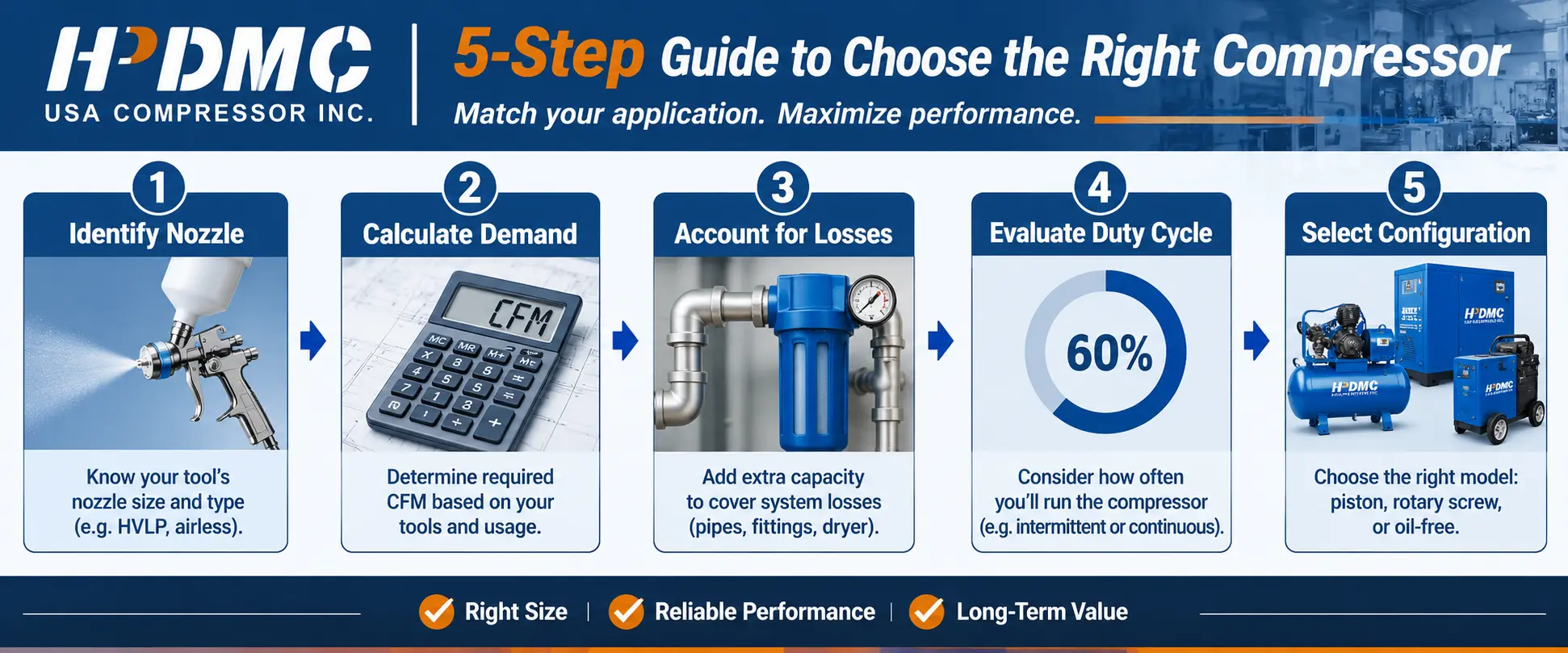
Use the following steps to evaluate your application.
Step 1: Identify Your Blasting Nozzle
Record the nozzle manufacturer, model, diameter, and expected operating pressure.
Use the manufacturer's airflow chart to determine the nozzle's air consumption.
Step 2: Calculate Total Air Demand
If you operate multiple blasting nozzles or other pneumatic equipment simultaneously, calculate the combined airflow demand.
💡 Do not add equipment that operates at different times as though everything runs continuously. Instead, identify the highest realistic simultaneous demand.
Step 3: Account for Pressure Losses
Review the complete compressed-air delivery system, including:
- Air hose diameter and length
- Couplings and connectors
- Moisture separators
- Aftercoolers and filters
- Additional distribution piping
⚠️ A restrictive or undersized delivery system can reduce pressure at the nozzle even when the compressor has sufficient nominal capacity.
Step 4: Evaluate the Duty Cycle
Some blasting operations run intermittently, while others require extended continuous operation.
A compressor selected for occasional blasting may not be appropriate for a production environment operating throughout the workday.
Confirm the compressor's rated duty cycle and whether it can sustain the application's actual demand.
Step 5: Select the Right Compressor Configuration
Consider whether your operation needs a stationary industrial compressor, a portable diesel-driven unit, or a custom mobile configuration.
For outdoor and remote blasting projects, diesel-driven rotary screw compressors may offer practical advantages where reliable electrical power is unavailable.
📖 You can also review HPDMC's 185 CFM compressor configurations for heavy-duty applications and discuss your nozzle, pressure, and site requirements with the technical team.
6. Why Consider a Diesel Rotary Screw Compressor for Sandblasting?
A diesel-driven rotary screw compressor can be a practical option for mobile and outdoor abrasive blasting operations.
Unlike a small workshop compressor intended for intermittent use, an appropriately specified industrial rotary screw package can be configured for demanding applications that require sustained compressed-air delivery.
Potential advantages include:
🔌 Independent Power for Remote Job Sites
A diesel engine allows the compressor to operate without depending on a fixed electrical connection. This can be useful for construction sites, infrastructure projects, and remote surface preparation work.
💨 High-Volume Air Supply
A high-output compressor can support blasting equipment with substantial airflow requirements, provided the delivered CFM matches the nozzle and operating pressure.
🚛 Mobile Project Flexibility
Depending on the configuration, the compressor may be integrated into a skid, trailer, or service vehicle.
⚠️ Before selecting a mobile package, confirm its dimensions, weight, lifting points, transport requirements, and available service access.
⏱️ Suitability for Extended Operations
Rotary screw technology is commonly used in industrial applications that require sustained compressed-air supply. However, the actual duty-cycle rating must be confirmed for the specific compressor package.
📖 For a broader comparison of mobile compressor requirements, read our truck-mounted air compressor guide.
⛔ Safety reminder: Diesel compressors must be operated outdoors with appropriate exhaust clearance. Never operate combustion-engine equipment in enclosed or poorly ventilated spaces. Follow the manufacturer's operating, fueling, and maintenance instructions.
7. Don't Overlook Moisture Control in Sandblasting
Air quality is another important part of a reliable blasting system.
Compressed air naturally contains moisture. When this moisture reaches the blasting equipment, it can contribute to abrasive clumping, inconsistent media flow, hose blockages, and surface-quality problems.
A complete system may require:
● An aftercooler
● A moisture separator
● An appropriately sized air dryer
● Suitable filtration
● Effective condensate drainage
💡 The correct combination depends on ambient temperature, humidity, compressor discharge conditions, and the blasting process.
📖 For more information about compressed-air moisture management, see HPDMC's guide to air dryers for compressed air systems.
⚠️ Do not assume that a compressor alone will provide the air quality required for every blasting application. Evaluate the entire air-treatment system.
8. 185 CFM vs. Larger Compressors: Which Should You Choose?
A 185 CFM compressor is not necessarily the best solution for every blasting project.
The right capacity depends on nozzle size, pressure, the number of operators, and the expected operating schedule.
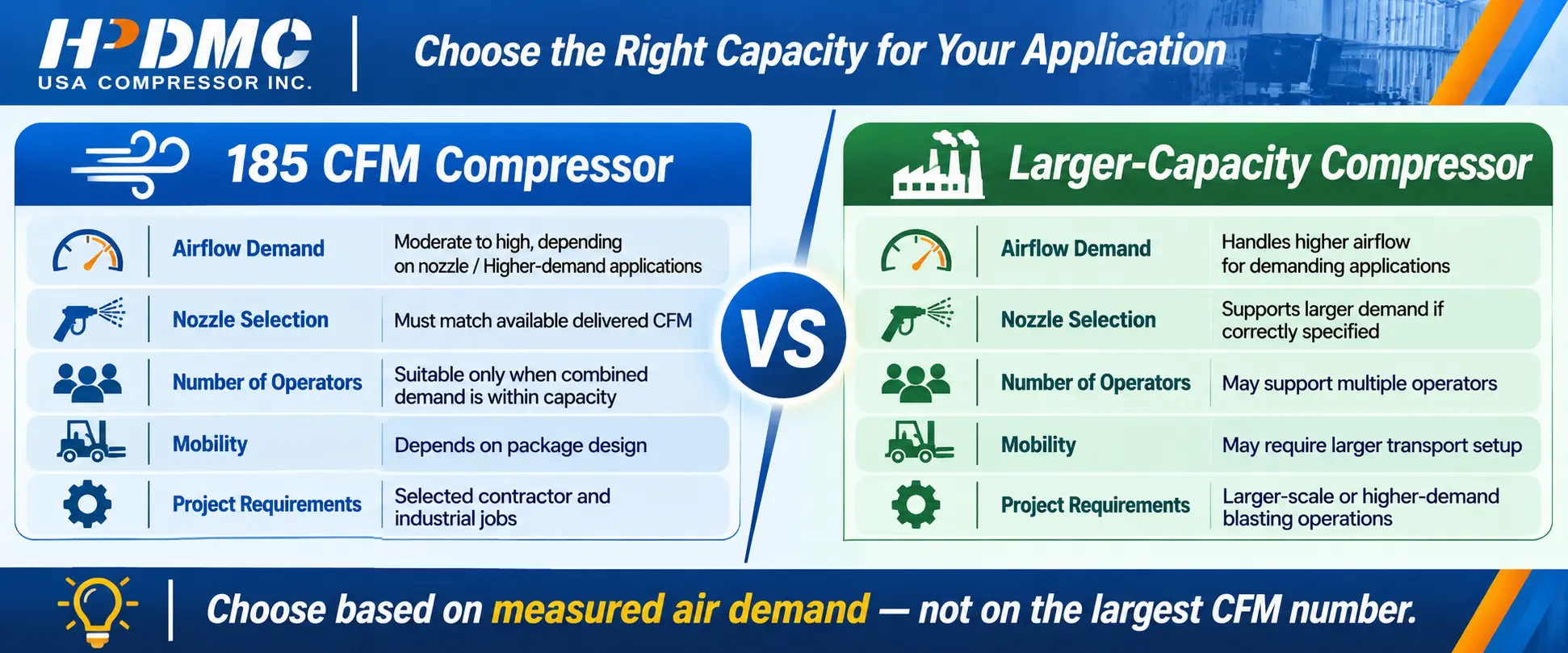
💡 Choose based on measured air demand rather than selecting a larger compressor simply because it appears more powerful.
If the calculated demand approaches or exceeds the compressor's actual delivered airflow, consider a higher-capacity configuration or revise the blasting setup.
9. Common Mistakes When Choosing a Sandblasting Compressor
Avoid these common selection mistakes:
❌ 1. Choosing by CFM alone
CFM without operating pressure does not provide enough information. Always compare airflow at the required PSI.
❌ 2. Ignoring nozzle wear
A worn nozzle may consume more air than expected. Inspect nozzle condition regularly.
❌ 3. Using undersized air hoses
A restrictive hose can create pressure losses and reduce blasting performance.
❌ 4. Ignoring moisture management
Moisture can interrupt abrasive flow and affect surface preparation quality.
❌ 5. Underestimating continuous air demand
A compressor that supports intermittent operation may struggle with extended blasting sessions.
❌ 6. Failing to confirm the actual configuration
Before purchasing, verify delivered airflow, working pressure, engine specifications, duty-cycle rating, air-treatment options, and mobility requirements.
❓ Frequently Asked Questions
Q1: Is a 185 CFM air compressor enough for sandblasting?
It may be suitable for selected sandblasting setups, depending on nozzle size, operating pressure, hose losses, and duty cycle. Compare the compressor's delivered airflow with the nozzle manufacturer's requirements before purchasing.
Q2: How much CFM does a sandblasting nozzle need?
Air consumption depends on nozzle diameter and operating pressure. As a reference, a No. 5 nozzle may require approximately 140 CFM at 100 PSI, while a No. 6 nozzle may require around 200 CFM under comparable reference conditions. Always verify the exact nozzle manufacturer's chart.
Q3: What PSI is best for abrasive blasting?
Many applications operate around 90–100 PSI at the nozzle. The correct pressure depends on the blasting equipment, abrasive media, and surface preparation requirements.
Q4: Is a diesel screw compressor suitable for sandblasting?
A diesel-driven rotary screw compressor may be suitable for mobile and outdoor blasting operations that require substantial airflow. Its actual suitability depends on delivered CFM, working pressure, duty cycle, and the complete air-treatment system.
Q5: Do I need an air dryer for sandblasting?
Moisture control is important in abrasive blasting. Depending on the operating environment and process, an aftercooler, moisture separator, air dryer, or combination of air-treatment components may be required.
Q6: What information should I provide when requesting a 185 CFM compressor quote?
Provide your nozzle size, required PSI, number of operators, operating hours, hose dimensions, site conditions, and mobility requirements. These details help determine whether a 185 CFM configuration is appropriate.
Q7: Can a 185 CFM compressor operate multiple sandblasting nozzles?
Only if the combined airflow demand at the required operating pressure is within the compressor's delivered capacity. Calculate the simultaneous demand of all nozzles and account for system pressure losses before selecting the compressor.
Need Help Selecting a Compressor for Your Blasting Project?
Contact HPDMC with your nozzle specifications, required pressure, and operating conditions. Our team can help review your airflow requirements and discuss a suitable compressor configuration.
👉 📞 Contact HPDMC | 🛒 Browse 185 CFM Air Compressors
✔️ Expert application guidance · ✔️ Custom-built configurations · ✔️ Factory-direct pricing

1-Year Warranty
Easy Returns

US-Based Support
Lifetime Technical Support

Help & Advice
service@sales.hpdmc-compressor.com

Live Help
(888)598-0133



Find the Right Compressor for Your Needs
Find the Right Compressor for Your Needs