1. Five Real-World Scenarios: Who Actually Needs a Truck Mounted Air Compressor
1.1 Truck Mounted Air Compressor for Mobile Mechanics
🔧 A mobile mechanic lives and dies by air: impact wrenches for lug nuts and suspension bolts, air ratchets for tight engine bays, blow guns for brake work. Every job site is different — a driveway, a parking lot, a highway shoulder — and there is never wall power. A truck mounted air compressor with its own engine means the mechanic pulls up, starts the compressor, and works. For a one-person operation running a 1/2-inch impact wrench and a ratchet (7–11 CFM combined), a 13 HP gasoline unit with a 30-gallon tank covers a full day of jobs on one tank of fuel. Our article on mobile air compressors breaks down the full mobile-power setup in more detail.
1.2 Truck Mounted Air Compressor for Tire Service Trucks
🛞 A tire service truck has a bursty air profile: short, high-demand spikes for bead seating and inflation, with idle time between calls. Bead seating can demand 15–20 CFM for 3–5 seconds, and a truck-mounted tank absorbs that spike instantly. The mounting question matters more here than anywhere else — a tire truck already carries tires, a jack, and tools, so every pound of compressor is a pound of payload spent. A compact 30-gallon skid unit keeps the center of gravity low and leaves room for the tire inventory that actually generates revenue.
1.3 Truck Mounted Air Compressor for Utility and Line Crews
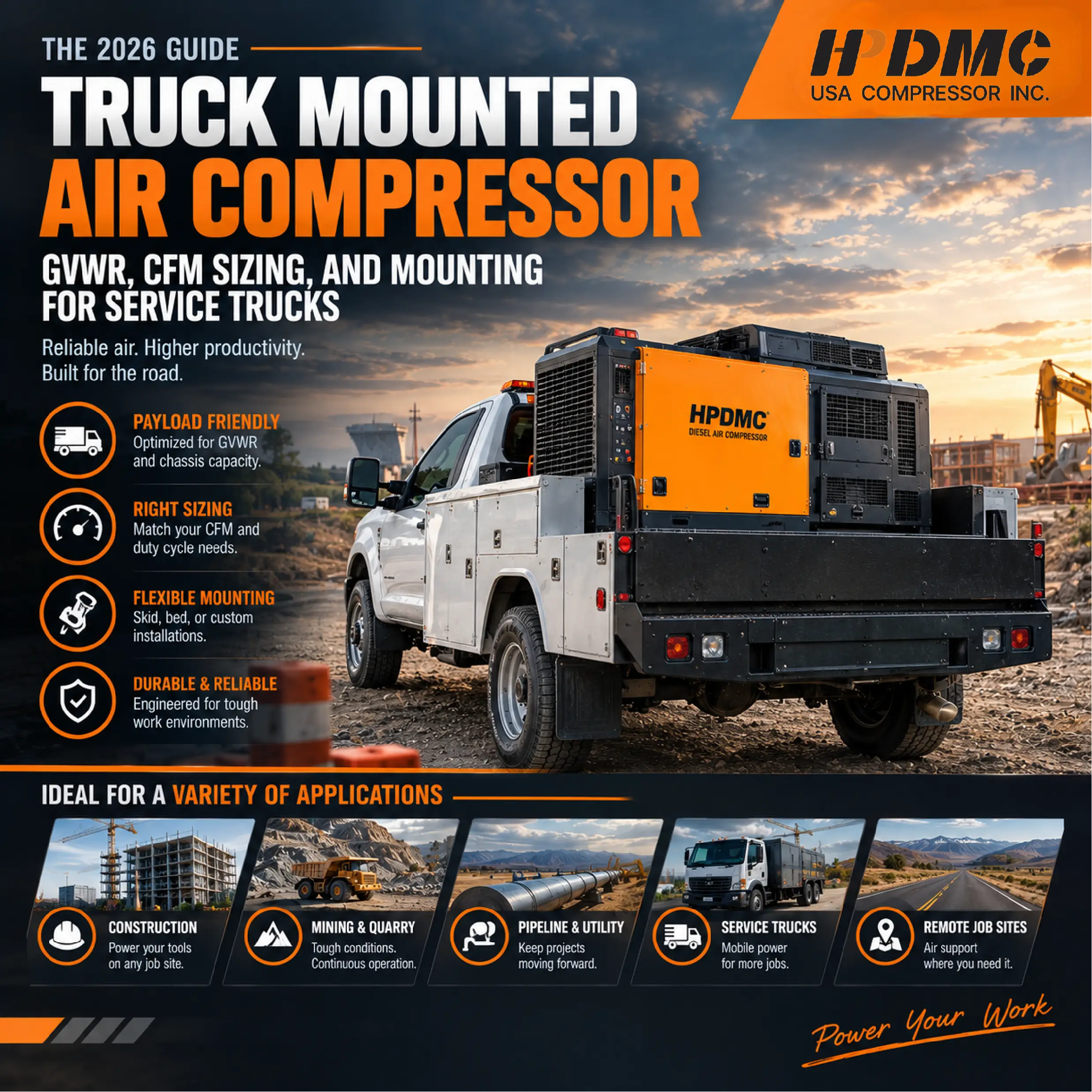
⚡ Utility and line crews run pneumatic tampers, cable blowers, and hydraulic tool power units from the truck bed, often on road shoulders where a trailer is impractical. These crews typically need 90–185 CFM sustained — far beyond what a small gasoline piston unit can deliver. This is skid-mounted diesel territory: a 185 CFM diesel screw package bolted to a flatbed or utility body gives a crew continuous air for a full shift, with the engine and compressor sharing one skid frame that isolates vibration from the chassis. For the diesel side of this decision, see our heavy-duty diesel compressor guide.
1.4 Truck Mounted Air Compressor for Road Repair and Pothole Crews
🚧 Road repair crews use jackhammers, pavement breakers, and air lances for pothole cleaning — tools that consume 60–90 CFM each at 90 PSI. A crew of two running one breaker and one air lance needs roughly 150 CFM, which again points to a skid-mounted diesel screw unit. The operational advantage of truck mounting here is speed: the crew parks, the compressor is already on the truck, and hoses run 50–100 feet to the work zone. No trailer to unhitch, no repositioning between potholes.
1.5 Truck Mounted Air Compressor for Field Welding and Fabrication Support
🛠️ Field welding rigs often carry a compressor alongside the welder for carbon arc gouging, plasma cutting support, and post-weld cleaning. These trucks are already payload-heavy, so the compressor choice comes down to weight per CFM. A small 6.5 HP gasoline unit handles gouging and cleaning air for a one-man rig; a welding truck that also runs pneumatic tools for the fitter should size up. If your rig is deciding between combining power sources or running separate units, our comparison of compressor-with-generator vs standalone setups walks through exactly that trade-off.
2. How to Spec a Truck Mounted Air Compressor: The Five Checks Before You Buy
2.1 Check One: GVWR and Payload — Do the Math First
📏 This is the check most buyers skip, and it is the one that causes the most expensive mistakes. Every truck has a Gross Vehicle Weight Rating (GVWR), and everything on the truck — fuel, tools, crew, cargo, and the compressor — must stay under it. A skid-mounted diesel screw package can weigh 1,500–2,500 lbs fully fueled; a 30-gallon gasoline piston unit runs 400–600 lbs. Before buying, weigh your truck as you actually run it — full fuel, full tool boxes, average crew — and subtract from GVWR. What remains is your real compressor budget. Overloading the rear axle is not just a DOT violation; it changes braking distance and voids chassis warranty claims.
2.2 Check Two: CFM Sizing for Your Actual Tool List
⚙️ List the tools you will run at the same time, add their CFM at 90 PSI, and multiply by 1.25. Typical truck-service tools:
• 1/2" impact wrench: 4–6 CFM
• Air ratchet: 3–5 CFM
• Tire bead seater: 15–20 CFM (burst)
• Pavement breaker / jackhammer: 60–90 CFM
• Carbon arc gouging: 20–30 CFM
Under 25 CFM total: a gasoline piston unit is the right size. Over 90 CFM sustained: you need a diesel screw package. Between the two, duty cycle decides — intermittent work favors gasoline, continuous work favors diesel.
2.3 Check Three: Drive Type — PTO vs Standalone Engine
🔩 There are two ways to drive a truck-mounted compressor:
PTO-driven: the truck engine drives the compressor through a power take-off. No second engine to maintain, but the truck engine must idle whenever you need air — burning fuel, adding engine hours, and locking the truck in place while you work.
Standalone engine: the compressor has its own gasoline or diesel engine on the skid. The truck engine can shut off, the compressor runs independently, and the package can be moved to another truck later. This is the configuration we recommend for most service-truck work.
PTO makes sense for fleets that standardized on it and run air continuously while parked at one site. For mobile mechanics and tire trucks that move between jobs, a standalone-engine skid is almost always the better fit.
2.4 Check Four: Mounting and Vibration Isolation
🔊 Road vibration is what kills truck-mounted compressors, not runtime hours. Three mounting rules from our field installations: (1) mount the skid to the frame with grade-8 hardware and isolation mounts, never to the bed floor alone; (2) keep the unit as far forward and as low as the layout allows to protect rear-axle loading and center of gravity; (3) use flexible hose sections at every rigid connection between the compressor and the truck, because chassis flex will crack hard lines over time. A properly isolated installation adds a few hundred dollars and doubles the service life of the pump.
2.5 Check Five: Air Delivery — Hose Reel, Length, and Winter Starts
❄️ Two practical details decide whether the installation works day-to-day. First, hose management: a truck-mounted setup should use a locking hose reel or a routed hose tray — loose hose in the bed is a trip hazard and gets run over at every job site. Second, cold starts: if the truck works below freezing, specify a cold-weather kit (block heater or glow plugs on diesel, synthetic oil rated for the climate) and a battery isolator so the compressor never drains the truck starting battery overnight. These are cheap options at order time and expensive retrofits.
3. Configuration Comparison: Three Truck-Mountable Setups
📊 Here is how three HPDMC configurations compare for truck mounting. The right choice depends on your CFM demand and payload budget, not on which unit is biggest.
| Configuration | Engine | CFM | Max PSI | Best Truck Application |
|---|
| 185 CFM Diesel Screw (skid) | Cummins diesel | 185 CFM | 125 PSI | Utility crews, road repair, heavy pneumatic tools |
| HSJQY209008 30Gal Gas | 13 HP gasoline | 24 CFM | 180 PSI | Mobile mechanics, tire service trucks |
| HSJQY306508 6.5HP Gas | 6.5 HP gasoline | ~12 CFM | 115 PSI | Light rigs, welding support, payload-limited trucks |
4. Which Truck Mounted Air Compressor Fits Your Operation?
4.1 For Utility Crews and Road Repair Fleets
185 CFM Diesel Screw Air Compressor (skid mounted) — 185 CFM at 125 PSI, Cummins diesel engine, skid frame. This is the configuration for crews that run jackhammers, tampers, and pavement breakers all shift. The rotary screw pump is rated for 100% continuous duty — no thermal shutdown mid-job — and the skid frame gives your upfitter one clean mounting interface with built-in vibration isolation points. Confirm your chassis payload before ordering: this package needs a one-ton flatbed or utility body with the GVWR headroom we calculated in Section 2.1.
4.2 For Mobile Mechanics and Tire Service Trucks
Two-Stage 30Gal Gasoline Piston Compressor — HSJQY209008 — 13 HP gasoline engine, 30-gallon ASME tank, 24 CFM at 180 PSI. This is the sweet spot for a mobile mechanic or tire service truck: enough CFM for an impact wrench, ratchet, and bead seater working in sequence, a 30-gallon tank that absorbs bead-seating spikes, and a two-stage pump that reaches 180 PSI so the tank stores more usable air per cubic foot. At 400–600 lbs installed, it leaves payload for the tools and parts that pay the bills.
5. Frequently Asked Questions
How much does a truck mounted air compressor weigh?
💡 It depends on the class. A compact 6.5 HP gasoline unit runs roughly 150–250 lbs. A 13 HP two-stage unit with a 30-gallon tank runs 400–600 lbs. A skid-mounted 185 CFM diesel screw package runs 1,500–2,500 lbs fueled. Always check the exact shipping weight on the product page and run the GVWR calculation from Section 2.1 before ordering — payload, not price, is usually the real constraint on a truck build.
Should I get a PTO-driven compressor or a standalone engine unit?
For most service-truck work, a standalone engine unit. PTO-driven compressors are cheaper to buy and have one less engine to maintain, but they force the truck engine to idle whenever you need air — adding engine hours, burning fuel, and making noise at every job site. A standalone gasoline or diesel skid lets the truck engine shut off while you work, and the whole package can be transferred to a replacement truck later. PTO makes sense mainly for fleets that already standardize on it and run air continuously at fixed sites.
Can I mount a compressor in the truck bed myself?
You can bolt one down, but a correct installation is more than bolts: grade-8 hardware into the frame or a load-rated bed mount, vibration isolation, flexible hose at every rigid connection, exhaust routed away from the cab, and a battery isolator if the unit has electric start. We provide mounting guidance with every skid order, and we recommend a professional upfitter for anything over 500 lbs — an improperly mounted unit is a projectile risk in a hard stop and a warranty issue if it cracks the bed.
What size truck mounted air compressor do I need for a mobile mechanic business?
🔧 For a standard mobile mechanic running a 1/2-inch impact wrench, air ratchet, and blow gun — with occasional bead seating — a 13 HP two-stage unit with a 30-gallon tank (24 CFM at 180 PSI) is the proven configuration. It covers 90% of roadside and driveway jobs with reserve. If you also run a die grinder or do continuous sandblasting for restoration work, tell us before ordering — those tools change the sizing math, and we would rather spec you correctly than sell you an undersized unit.
Do truck mounted air compressors need special DOT compliance?
📋 The compressor itself does not need DOT certification, but the installation must keep the truck within its GVWR and axle ratings — that is the DOT-enforceable part, and it is checked at weigh stations. Two related items: the ASME tank on the compressor is a pressure vessel and should carry current certification, and any fuel carried for the compressor engine counts toward hazardous-material thresholds only in large quantities — a normal day-tank is fine. Keep the compressor secured so it cannot shift in transit; load securement falls under FMCSA rules the same as any cargo.
Ready to Build Your Truck Mounted Air Compressor Setup?
Send us your truck model, GVWR, current loaded weight if you know it, and the tools you run. An HPDMC application engineer will run the payload math, match the right truck mounted air compressor to your CFM demand, and confirm the mounting and hose layout before you order — so the unit fits the truck the first time.
🛒 Get a Free Truck Fit Review · Browse Product Catalog
✔️ GVWR & payload check included · ✔️ Mounting guidance with every skid · ✔️ Honest sizing — no overselling