Oil-Free Scroll Air Compressors
Quiet, clean, 100% oil-free scroll compressors for medical, food, lab, and electronics applications. Custom configurations from 2 to 30 HP.
👉 Configure Your Scroll Compressor⚡Free Shipping: Ultra-Quiet Portable Oil-Free Air Compressor AWR800-18LM2
Need Help Choosing the Right Compressor?
Need Help Choosing the Right Compressor?
⚡Free Shipping: Ultra-Quiet Portable Oil-Free Air Compressor AWR800-18LM2
Need Help Choosing the Right Compressor?
⚡Free Shipping: Ultra-Quiet Portable Oil-Free Air Compressor AWR800-18LM2
Choosing between a scroll compressor and a rotary screw compressor is an important decision for businesses that depend on reliable compressed air. Both technologies can deliver consistent air for commercial and industrial applications, but they differ in compression design, available capacity, maintenance requirements, operating characteristics, and system configuration.
However, neither technology is automatically the best choice for every facility. The right compressor depends on your required airflow, operating pressure, air quality, duty cycle, installation environment, and total cost of ownership.
In this guide, we compare scroll and rotary screw air compressors to help you identify the right technology for your application.
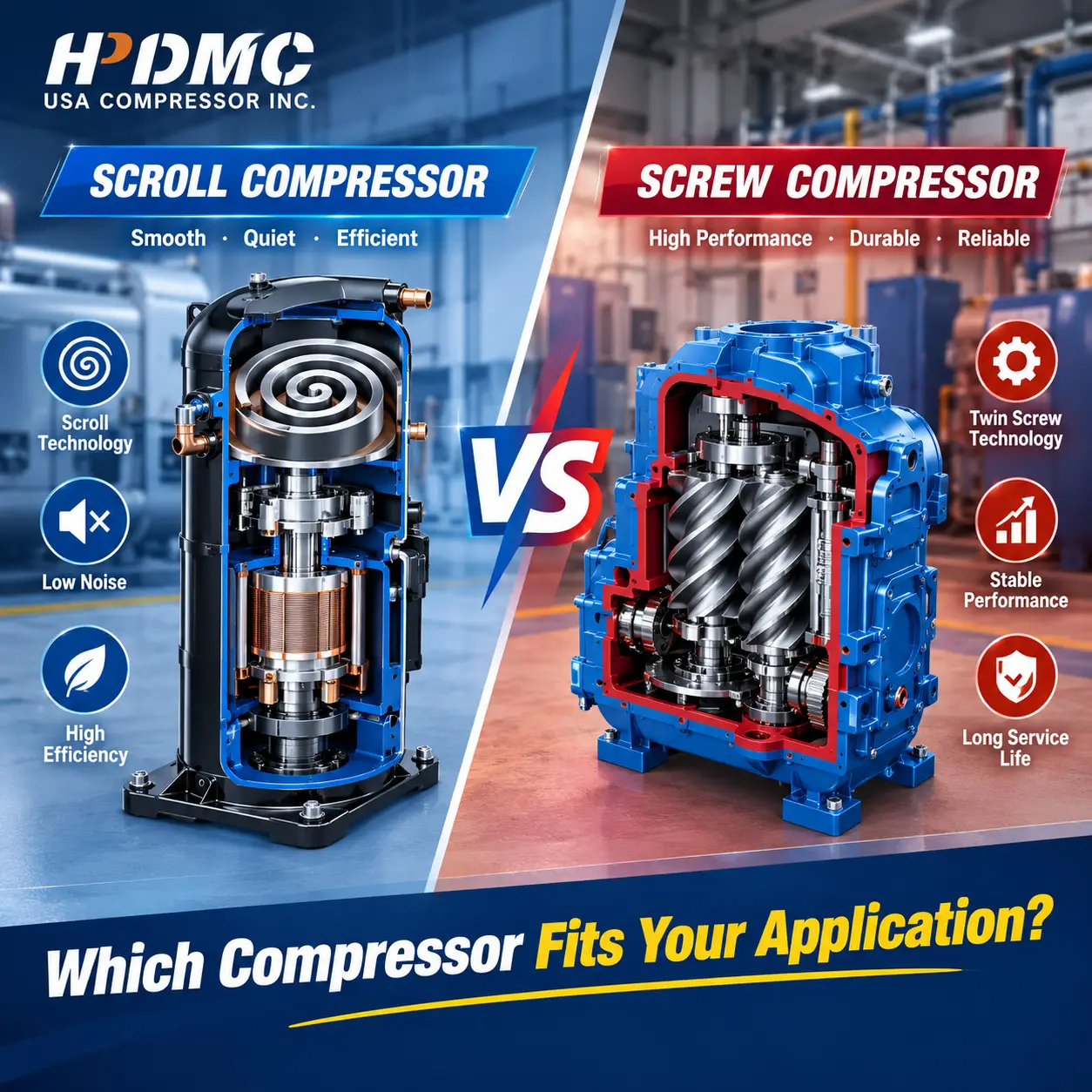
A scroll air compressor uses two spiral-shaped elements to compress air. One scroll remains stationary while the other orbits around it, trapping air in pockets that gradually move toward the center and decrease in volume.
This compression mechanism has relatively few moving compression components and does not rely on the reciprocating piston motion found in conventional piston compressors.
Oil-free scroll models are designed to compress air without introducing lubricating oil into the compression chamber. This makes them attractive for applications where oil contamination must be controlled.
✅Compact design: Suitable for installations where equipment footprint matters.
✅Low-noise potential: Scroll compression can provide smooth, relatively quiet operation, depending on the model and enclosure.
✅Oil-free compression options: Appropriate for applications requiring oil-free compressed air when the selected model meets the required air-quality specification.
✅Modular system potential: Multiple compressor units can be configured to meet changing airflow requirements when the system is properly engineered.
Scroll compressors are often considered for laboratories, dental and medical support systems, electronics-related processes, and smaller industrial applications. Suitability depends on the required air quality, capacity, pressure, and operating conditions.
📖 Learn more in HPDMC's guide to how oil-free air compressors work.
Explore HPDMC scroll compressor configurations for applications requiring oil-free compression and compact equipment.
Explore HPDMC scroll compressorsA rotary screw air compressor uses two intermeshing helical rotors to trap and compress air as it moves through the compression element.
Rotary screw compressors are widely used in manufacturing facilities, workshops, and industrial operations that need a steady supply of compressed air. Depending on the design, they can be configured for oil-injected or oil-free compression.
✅Broad capacity range: Available in configurations suitable for many small, medium, and large compressed-air systems.
✅Continuous-operation capability: Many models are designed for sustained operation within their specified operating limits.
✅Industrial applications: Commonly used to supply production equipment, pneumatic tools, and plant-wide compressed-air networks.
✅Multiple configuration choices: Options may include fixed-speed or variable-speed drives, air-cooled or water-cooled designs, and oil-injected or oil-free technologies.
📖 For a deeper look at sizing and configuration, see HPDMC's Rotary Screw Air Compressor Selection Guide.
The main difference is not simply that one compressor is quieter or that the other is more powerful. The important distinction is how each technology fits the capacity and operating requirements of a particular compressed-air system.
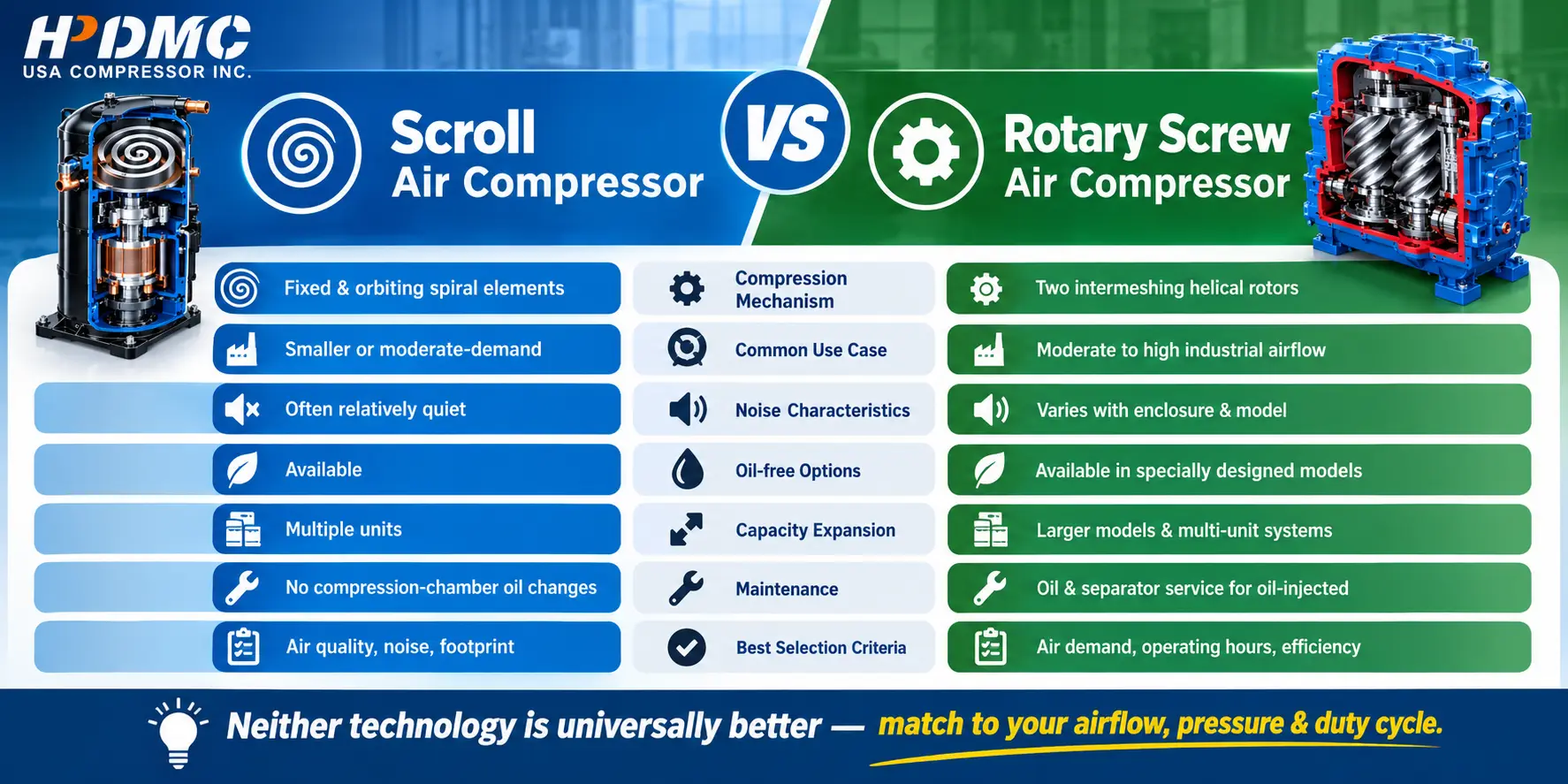
⚠️ Important: These are general technology characteristics, not guarantees for every model. Compare manufacturer specifications at the required pressure and airflow before making a purchasing decision.
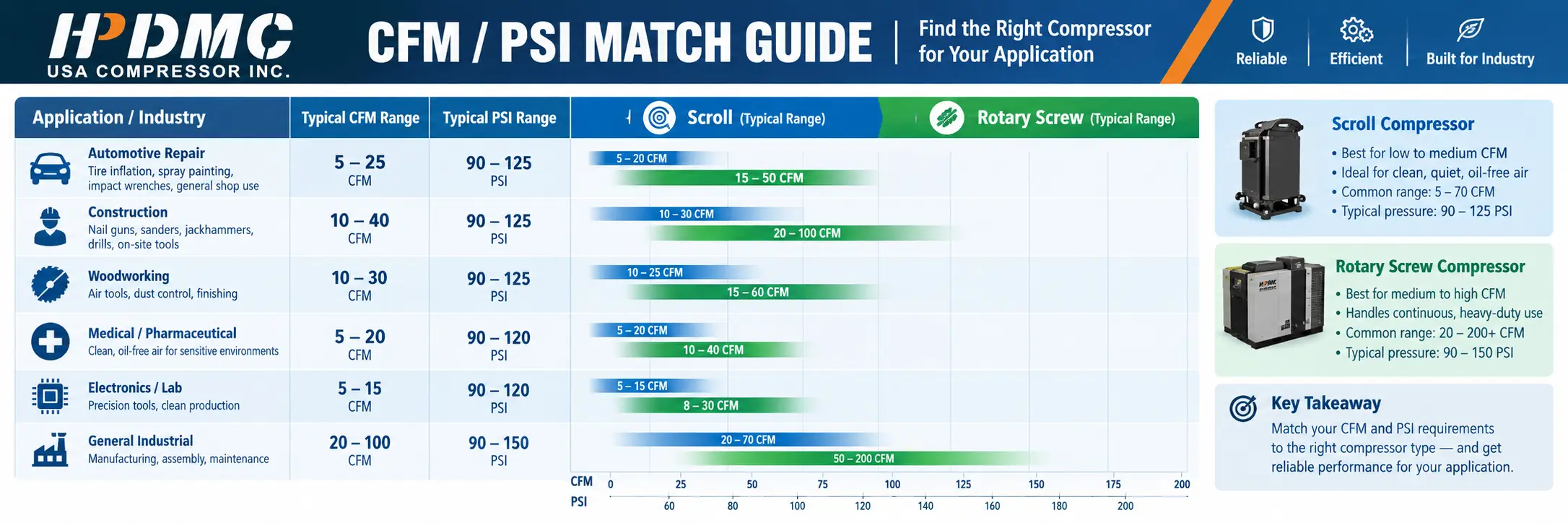
Airflow and operating pressure should be among the first specifications you evaluate.
Both must meet the requirements of your equipment.
A scroll compressor may be a good fit when the application requires moderate airflow and the available scroll model can supply the required CFM at the target pressure.
It can be particularly attractive when quiet operation, compact installation, or oil-free compression is important.
Before choosing a model, confirm:
● Required CFM at operating pressure
● Maximum and normal operating pressure
● Expected daily operating hours
● Whether air demand changes significantly during the day
● Whether the compressor can support peak demand without excessive cycling
A rotary screw compressor is often a strong candidate when a facility needs a sustained supply of compressed air for multiple machines or production processes.
It may be appropriate for manufacturing lines, larger workshops, and facilities with substantial or relatively continuous air demand.
Before selecting a rotary screw model, determine:
● Total airflow demand across connected equipment
● Simultaneous peak demand
● Operating pressure at the point of use
● Whether demand varies throughout the production cycle
● Whether a fixed-speed or variable-speed configuration suits the load profile
⚠️ Do not choose based on horsepower alone. A compressor must deliver sufficient usable airflow at the pressure your equipment actually needs.
Energy consumption can be a major part of the lifetime cost of an industrial air compressor. However, it is not accurate to declare one compression technology universally more efficient than the other.
Actual efficiency depends on the compressor model, operating pressure, motor and drive efficiency, load profile, control system, cooling requirements, and maintenance condition.
When evaluating a scroll compressor, consider:
1. Electrical consumption at the expected operating load
2. Whether the unit runs continuously or cycles on and off
3. The efficiency of the proposed multi-unit configuration, if applicable
4. Replacement parts and service requirements
5. The cost of meeting the application's air-quality requirements
⚠️ A quieter or smaller compressor is not necessarily the lowest-cost option over its entire service life. Compare measured or manufacturer-supplied performance data.
For rotary screw systems, consider:
1. Specific power or power consumption at the required airflow
2. Fixed-speed versus variable-speed operation
3. Oil, filters, separators, and other scheduled service items where applicable
4. Cooling and ventilation requirements
5. Pressure losses throughout the compressed-air distribution system
6. Operating hours and variations in demand
A variable-speed model may help when demand fluctuates substantially, but savings depend on the actual load profile and system design.
📊 For a meaningful comparison, calculate expected annual electricity use and maintenance costs using the same operating assumptions for both options.
The installation environment can help narrow the choice.
Scroll compressors are worth evaluating when the compressor will be installed near staff, work areas, or equipment that benefits from a quieter environment.
Potential applications include laboratories, small production rooms, and workshops where space is limited.
However, actual sound levels vary. Check the published noise rating, installation instructions, cooling-air requirements, and recommended clearances for the exact model.
Rotary screw systems are commonly installed in dedicated compressor rooms or designated industrial equipment areas.
The installation should provide adequate ventilation, service access, electrical capacity, and a suitable environment for the compressor and its associated equipment.
Larger systems may also require careful planning for air receivers, dryers, filters, condensate management, and distribution piping.
⚠️ Neither technology should be installed without considering the manufacturer's ventilation, clearance, temperature, and electrical requirements.
Maintenance requirements differ by compressor design and should be evaluated using the manufacturer's service schedule.
Oil-free scroll compressors generally do not require compressor-oil changes for the compression chamber. However, that does not make them maintenance-free.
Typical maintenance considerations may include:
1. Intake air filter inspection and replacement
2. Cooling-air passage cleaning
3. Condensate drain inspection, where fitted
4. Checking for unusual noise, vibration, or temperature changes
5. Inspection and replacement of wear components according to the manufacturer's schedule
6. Electrical and safety-system checks
📖 For model-specific service procedures, consult HPDMC's Scroll Air Compressor Maintenance Guide.
Maintenance depends on whether the compressor is oil-injected or oil-free.
1. Oil-injected rotary screw compressors typically require scheduled attention to lubricating oil, oil filters, air filters, oil separators, and cooling components.
2. Oil-free rotary screw compressors have different service requirements and should be maintained according to their own manuals.
💡 For either technology, preventive maintenance helps protect performance and reduce the risk of unplanned downtime.
Some buyers are not comparing scroll and screw mechanisms alone. They are also deciding whether their compressed-air system should use oil-free or oil-injected compression.
These are two separate decisions:
⚠️ If the application requires certified oil-free air, verify the exact model's certification and the complete system's air-quality requirements. Do not assume that the term "oil-free" alone establishes compliance with a particular air-purity class.
📖 For a broader comparison of lubrication technologies, read HPDMC's Oil vs. Oil-Free Air Compressors guide.
Use the following guide as a starting point, then confirm the required CFM, PSI, air quality, and duty cycle.
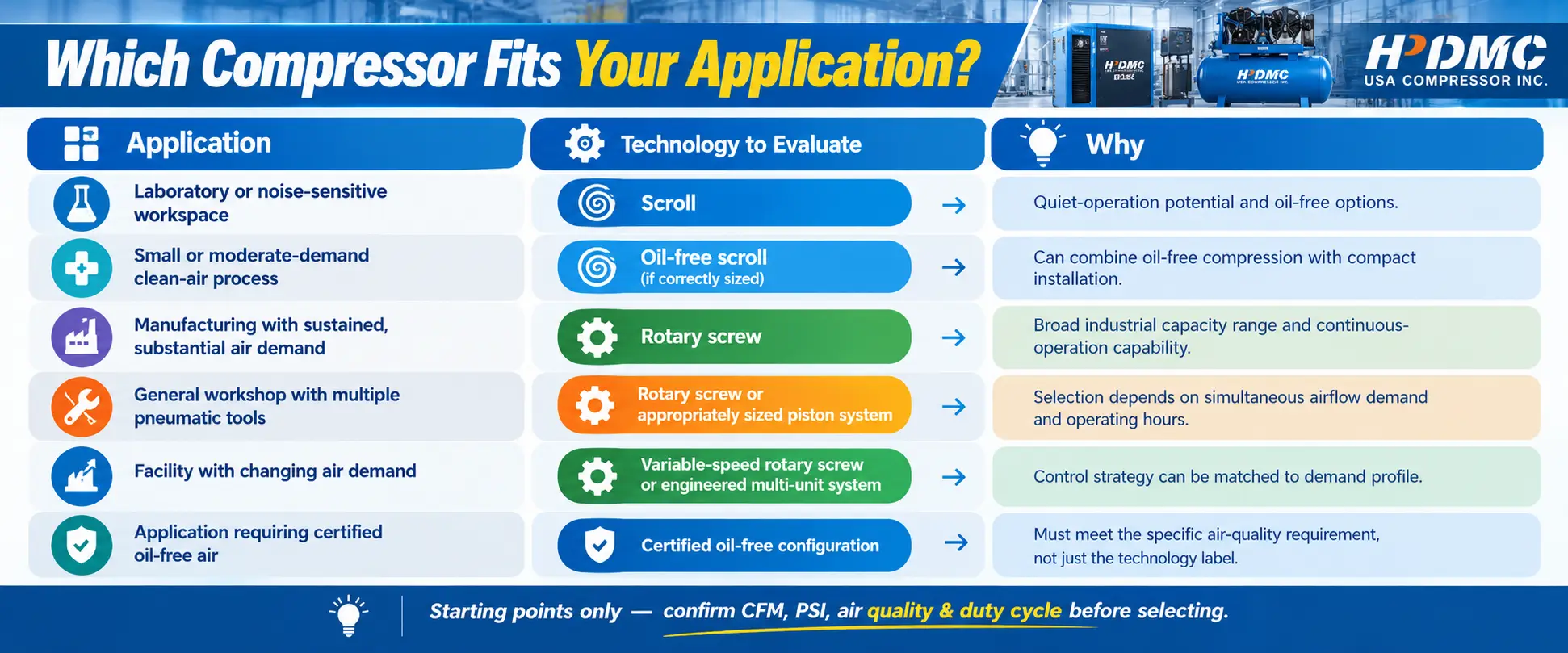
💡 These recommendations are starting points rather than universal rules. A properly sized scroll system can serve some demanding applications, and rotary screw technology is available in different capacity and air-quality configurations.
Before requesting a quotation, collect the following information.
1️⃣ Required airflow: Add the actual air consumption of equipment that may operate simultaneously, accounting for intermittent demand and future expansion.
2️⃣ Required pressure: Confirm the operating pressure required at the point of use, including pressure losses through piping, filters, dryers, and regulators.
3️⃣ Air quality: Determine whether the process requires oil-free air or a defined compressed-air purity class.
4️⃣ Operating profile: Record daily operating hours, peak demand, and how much airflow varies during production.
5️⃣ Installation conditions: Check available space, ventilation, ambient temperature, electrical supply, and noise restrictions.
6️⃣ Maintenance and service: Compare scheduled service tasks, parts availability, and the support available for the selected model.
7️⃣ Total cost of ownership: Evaluate purchase price, electricity, maintenance, air treatment, and anticipated operating life.
8️⃣ Future capacity: Consider whether demand may grow and whether adding another compressor or selecting a larger configuration would be practical.
💡 This information helps suppliers recommend a system based on your actual operating requirements rather than horsepower alone.
Neither is universally better. Scroll compressors may be attractive for compact, quieter, oil-free applications. Rotary screw compressors are widely used for sustained industrial airflow. The correct choice depends on capacity, pressure, duty cycle, air quality, and operating costs.
Scroll compressors can provide relatively quiet operation, but the actual sound level depends on the model, enclosure, cooling system, and installation. Compare published noise ratings under comparable conditions before deciding.
Some scroll compressors are designed for extended operation, but allowable duty cycle depends on the specific model and operating conditions. Confirm the manufacturer's rating rather than assuming all scroll compressors can run continuously.
No. Scroll compressor lubrication arrangements vary by design. If oil-free compression is required, choose a model explicitly designed for oil-free operation and verify its technical documentation.
Some rotary screw compressors are designed for oil-free compression, while many conventional models are oil-injected. Check the specific model's design and air-quality documentation.
There is no universal winner. Efficiency depends on the model, airflow, pressure, operating hours, control strategy, and load profile. Compare performance data at the operating conditions you expect to use.
Start with the CFM and PSI requirements of your equipment, including simultaneous demand and expected future growth. Then compare compressor performance at the required pressure and evaluate the system's storage, air treatment, and distribution needs.
Scroll and rotary screw air compressors serve different needs, but the right decision is not based on technology labels alone.
Compare the required CFM, PSI, air quality, operating profile, installation conditions, maintenance requirements, and lifetime cost before selecting a model.
📞 If you are unsure which configuration fits your facility, share your airflow and pressure requirements with HPDMC so the recommended system can be matched to your actual application.
👉 Contact HPDMC | Browse Scroll Air Compressors
✔️ Expert application guidance · ✔️ Oil-free and rotary screw options · ✔️ Factory-direct pricing
Quiet, clean, 100% oil-free scroll compressors for medical, food, lab, and electronics applications. Custom configurations from 2 to 30 HP.
👉 Configure Your Scroll CompressorFind the right portable air compressor for home, workshop, or job site. Compare electric and gas models by CFM, PSI, tank size, and noise.
👉 Find Your Portable CompressorCompare oil-free and oil-lubricated air compressors side by side. Understand maintenance, air purity, lifespan, and best applications.
⚖️ Compare Compressor Types
1-Year Warranty
Easy Returns

US-Based Support
Lifetime Technical Support

Help & Advice
service@sales.hpdmc-compressor.com

Live Help
(888)598-0133



Find the Right Compressor for Your Needs
Find the Right Compressor for Your Needs