summary
About this guide. Written by the HPDMC compressor engineering team, which has sized and shipped gas-driven compressors to framing crews, roofing contractors, fencing teams, mobile mechanics, and remote service operations across the U.S. since 2004. Everything below comes from machines we have actually fielded: Kohler industrial engine service data, cast-iron pump behavior on dusty job sites, ASME-certified tank specifications, and OSHA carbon monoxide guidance. There are no paid placements, and where gas power is the wrong answer, we say so.
Air gas compressors — gasoline-engine-driven air compressors — exist for one reason: the work is happening where grid power is not. A framing crew on a new slab, a fencing team miles down a rural property line, a mobile mechanic on a highway shoulder — none of them can drag out 200 feet of extension cord and hope the breaker holds. A gas compressor carries its own power plant. This guide covers how to choose one honestly: engine class, pump construction, CFM math, tank size, and the safety rules that come with burning gasoline. See the full current lineup at hpdmc-compressor.com before you decide.
1. When Gas Power Is the Right Call (and When It Is Not)
1.1 The Honest Test: Where Does the Work Actually Happen?
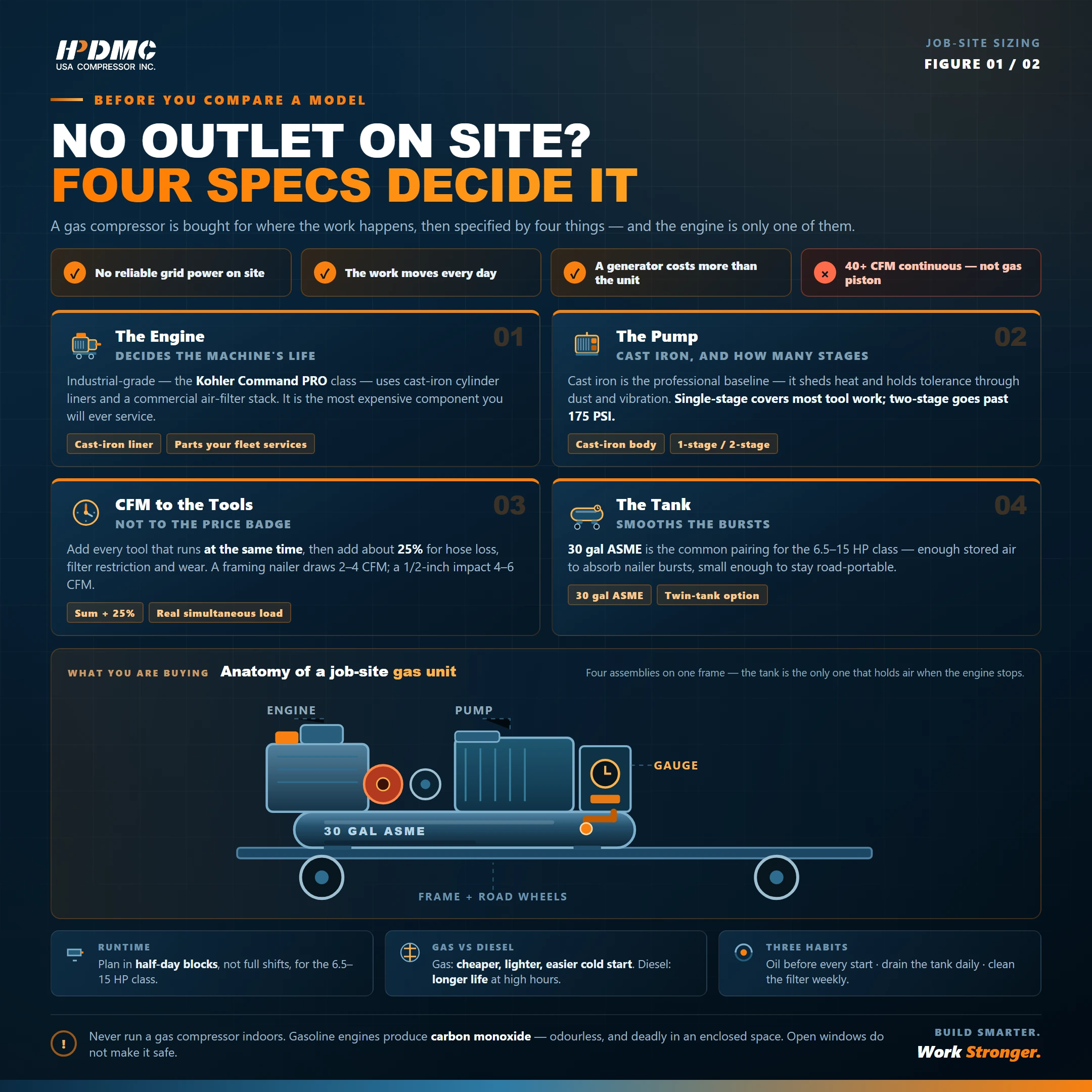
💡 Buy air gas compressors when the job site has no reliable power, when the work moves every day, or when running a generator to feed an electric compressor would cost more than the gas unit itself. That covers most construction, agriculture, and mobile service work. Do not buy gas for a fixed indoor shop: gasoline engines produce carbon monoxide, and no amount of ventilation makes indoor operation safe. If your work is indoors with an outlet available, an electric machine is cheaper to run, quieter, and safer — gas only earns its keep when the outlet is missing.
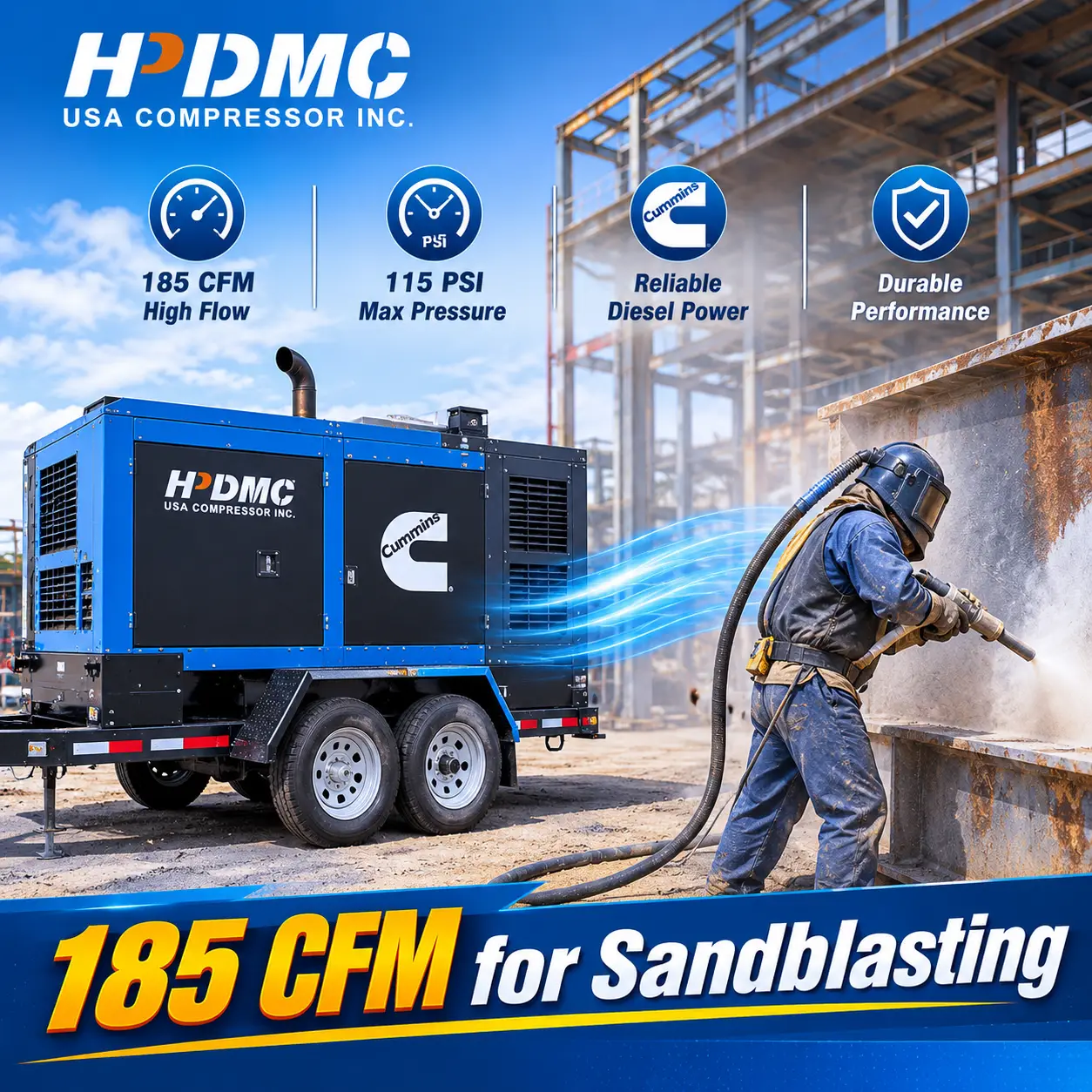
The second honest test is duty profile. A gas piston compressor is built for intermittent and shifting demand — nailers, impact wrenches, blow guns, tire inflation. If you need 40+ CFM continuously for production sandblasting, a gas piston unit is the wrong machine regardless of brand, and you should be looking at large diesel or electric screw classes instead.
2. How to Choose: Engine, Pump, CFM, Tank
2.1 The Engine Decides the Machine's Life
⚙️ The engine is the most expensive component you will ever service, so read its spec line carefully. Industrial-grade engines — the Kohler Command PRO class — are built with cast-iron cylinder liners, forged crankshafts, and service intervals measured in thousands of hours. Consumer-grade engines borrowed from lawn equipment are not. Two compressors can look identical on paper and differ by years of service life purely on the engine badge. Also confirm the fuel: most job-site units run regular unleaded gasoline, which keeps fuel logistics simple on mixed-fleet sites.
2.2 Pump Construction: Cast Iron and Stages
A cast-iron pump is the baseline for professional use — it dissipates heat, holds tolerances, and survives the dust and vibration of a job site. Single-stage pumps cover most tool work up to about 125–150 PSI; two-stage pumps compress air twice and reach higher pressures (180 PSI class) more efficiently, which matters when you run long hose lengths or high-pressure tools. If a spec sheet does not name the pump material, treat that as a warning.
2.3 Size the CFM to the Tools, Not the Badge
Add up the CFM of every tool that will run at the same time, then add roughly 25% for hose loss, filter restriction, and wear. A framing nailer draws 2–4 CFM, a 1/2-inch impact wrench 4–6 CFM, a roofing nailer similar. Three nailers working at once is a 10–15 CFM real-world demand — which is exactly why the 18 CFM class is the contractor standard rather than an upgrade. For the full walkthrough of how HP, PSI, and CFM interact, our gas-powered compressor job-site guide goes deeper than any catalog page can.
2.4 The Tank Smooths the Bursts
A 30-gallon ASME tank is the common pairing for the 6.5–15 HP gas class: enough stored air to absorb nailer bursts and tool pulses without the engine cycling constantly, small enough to stay road-portable. The tank must be ASME-certified — it is a pressure vessel, and certification is not optional. Horizontal tanks ride lower in a truck bed or trailer; the mounting style matters as much as the gallon count if the machine travels daily.
3. Four Job Profiles, Four Different Needs
3.1 Framing and Roofing Crews
🏗️ Two to three nailers firing in bursts is the classic framing load: 6–12 CFM of real demand with sharp spikes every time a nailer cycles. A gas unit in the 18 CFM class keeps a whole crew fed without the engine screaming between bursts. Roofing adds hose length — runs up a ladder bleed pressure, which is why headroom above the calculated CFM matters more on a roof than on the ground.
3.2 Mobile Mechanics and Service Trucks
🛞 A service truck is a rolling shop: impact wrenches, air ratchets, tire inflation, and sometimes welding and electrical work on the same call. This is the profile where a single-engine multi-function unit earns its space — one gas engine driving compressed air, welding output, and generator power replaces three separate machines and several hundred pounds of payload. If your truck bills by the hour, the loading and unloading time alone justifies consolidation.
3.3 Agriculture, Fencing, and Rural Work
🚜 Post drivers, nailers, and impact tools miles from the nearest outlet: rural work is where air gas compressors stop being convenient and start being essential. The selection priorities here are engine reliability and air-filter service, because dust is the killer — check the filter weekly in dry conditions and keep a spare element on the truck.
3.4 Remote Construction and Maintenance Sites
Pipeline, utility, and maintenance crews work where nothing is plugged in. The rule for remote sites: fuel autonomy and parts simplicity. Choose a unit whose engine your fleet already services, and confirm the tank and pump service parts ship domestically — a two-week parts lead time on a remote job is a schedule failure, not an inconvenience.
4. Matching Tools to Machines
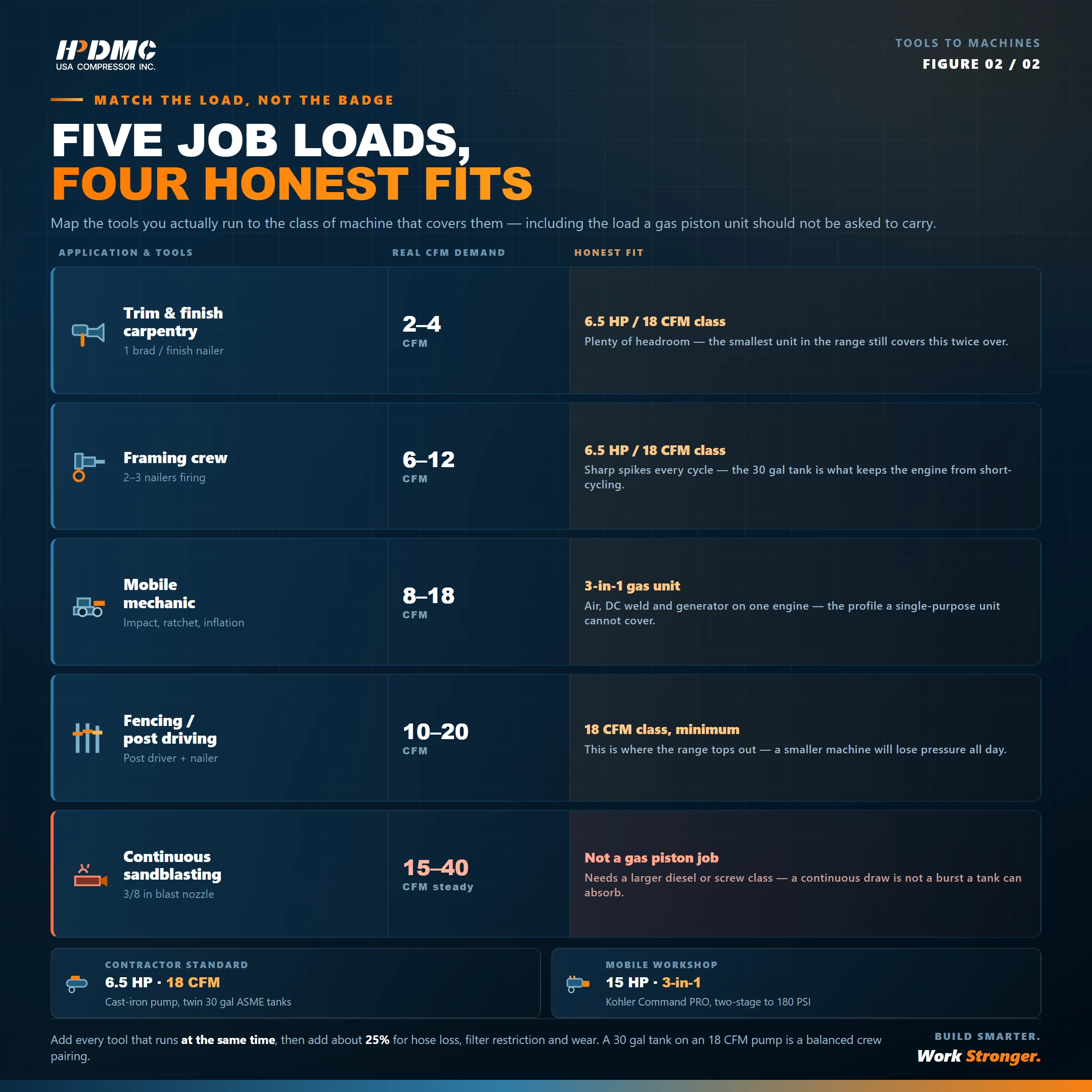
📊 The table below maps common job-site loads to the class of machine that actually covers them — including the loads a gas piston unit should not be asked to carry.
| Application | Typical Tools | Real CFM Demand | Honest Fit |
|---|
| Trim & finish carpentry | 1 brad/finish nailer | 2–4 CFM | 6.5 HP / 18 CFM class |
| Framing crew (2–3 nailers) | Framing nailers | 6–12 CFM | 6.5 HP / 18 CFM class |
| Mobile mechanic | Impact, ratchet, inflation | 8–18 CFM | 3-in-1 gas unit |
| Fencing / post driving | Post driver + nailer | 10–20 CFM | 18 CFM class minimum |
| Continuous sandblasting | 3/8" blast nozzle | 15–40 CFM steady | Not a gas piston job — larger diesel or screw class |