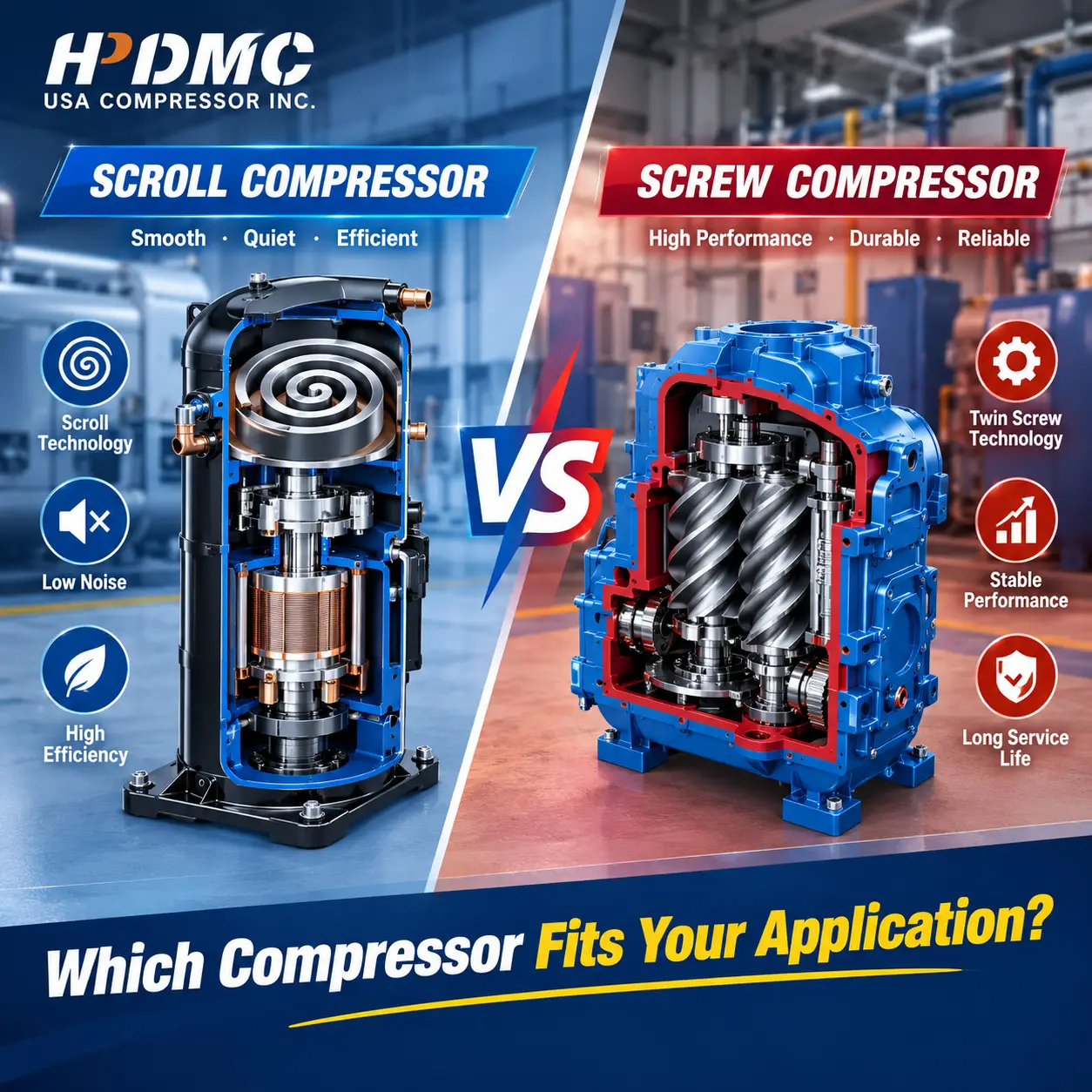
Oil-Free Scroll Air Compressors
Quiet, clean, 100% oil-free scroll compressors for medical, food, lab, and electronics applications. Custom configurations from 2 to 30 HP.
👉 Configure Your Scroll Compressor⚡Free Shipping: Ultra-Quiet Portable Oil-Free Air Compressor AWR800-18LM2
Need Help Choosing the Right Compressor?
Need Help Choosing the Right Compressor?
⚡Free Shipping: Ultra-Quiet Portable Oil-Free Air Compressor AWR800-18LM2
Need Help Choosing the Right Compressor?
⚡Free Shipping: Ultra-Quiet Portable Oil-Free Air Compressor AWR800-18LM2
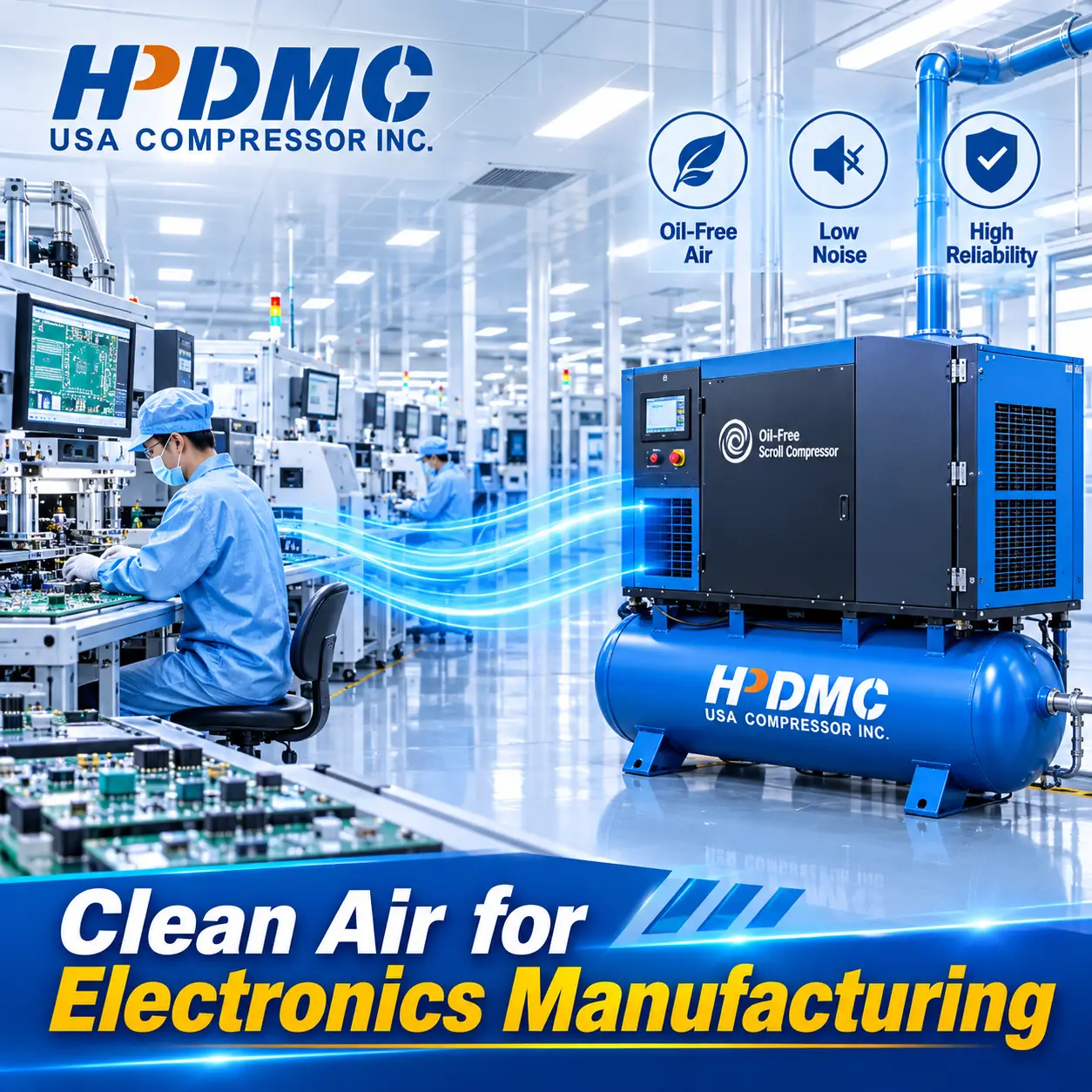
In electronics manufacturing, compressed air is more than a utility. It is part of the production environment.
From SMT pick-and-place equipment and PCB handling systems to conformal coating preparation, precision dispensing, and fixture cleaning, compressed air supports processes where contamination and moisture can affect product quality.
This creates an important equipment-selection question:
What kind of compressed air does an electronics production line actually need?
Choosing an oil-free compressor is an important starting point, but it does not automatically guarantee clean, dry air at every point of use. Engineers must also define the required oil purity, particle concentration, pressure dew point, airflow, and system reliability.
This guide explains how to select an air compressor for electronics manufacturing, how to interpret ISO 8573-1 air purity classes, and when an oil-free scroll or rotary screw compressor makes sense.
Compressed air can serve several functions throughout an electronics production facility. Some applications use air directly in the manufacturing process, while others use it to operate equipment or maintain production conditions.
Understanding these applications is the first step in defining the correct air quality.
SMT pick-and-place machines use vacuum systems to pick up and position small electronic components.
Compressed air may power pneumatic actuators and Venturi vacuum generators, depending on the machine design.
⚠️ Unstable pressure or insufficient airflow can affect equipment operation, vacuum generation, and production consistency. Air quality requirements should be checked against the machine manufacturer's specifications.
Pneumatic fixtures, positioning systems, and PCB handling equipment may rely on compressed air for controlled movement and clamping.
Moisture, particulate contamination, or unstable pressure can contribute to equipment problems, particularly in precision pneumatic components.
Before conformal coating, printed circuit boards may undergo cleaning, drying, or air-assisted surface preparation.
This is a particularly sensitive application because oil contamination can interfere with surface wetting and coating adhesion.
⚠️ Even contamination that is not visible as an obvious oil film may create surface defects, including poor coating coverage, dewetting, or localized coating separation.
Some dispensing and assembly systems use compressed air to control pneumatic movement or material delivery.
Pressure stability and cleanliness can influence repeatability, especially in processes involving small volumes and precision positioning.
Compressed air is frequently used for equipment cleaning and removing loose particles from fixtures or production tooling.
⚠️ The air itself must be suitable for the task. Using contaminated compressed air to clean a supposedly clean surface can introduce another source of contamination.
A common approach is to purchase a conventional oil-lubricated compressor and add high-efficiency filters downstream.
Although filtration is an important part of compressed-air treatment, it should not be treated as a substitute for the right compressor technology.
Oil-lubricated compressors can introduce oil in liquid, aerosol, and vapor forms. Different treatment components have different removal capabilities, and downstream filters cannot be assumed to eliminate every contaminant under every operating condition.
💡 Filter performance also depends on correct sizing, installation, maintenance, and operating conditions.
For sensitive electronics applications, an oil-free compressor can reduce the risk of oil contamination at its source. Appropriate filtration and air treatment are still necessary to control particles, moisture, and other contaminants.
When specifying compressed air for electronics manufacturing, engineers should define three separate contaminant categories:
ISO 8573-1 provides a classification system for these contaminants.
💡 A compressed-air specification should identify the required class for each category rather than simply stating that the air must be "clean" or "oil-free."
Oil purity classes cover total oil, including liquid oil, oil aerosol, and oil vapor.
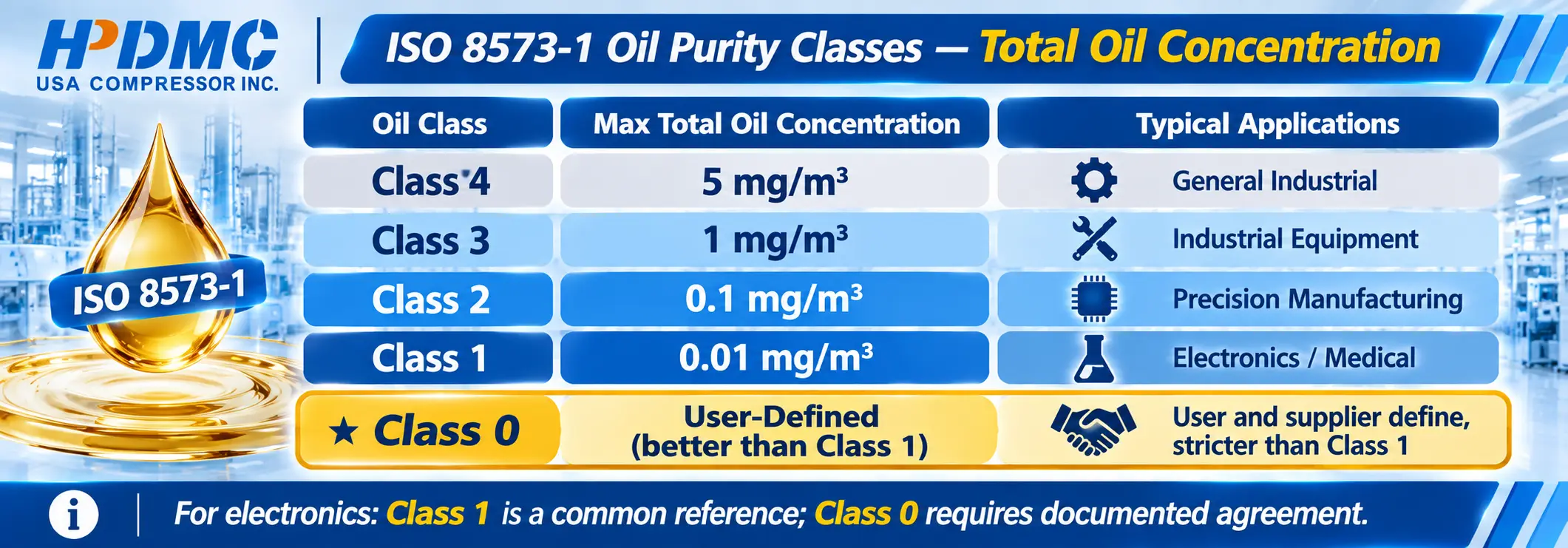
For sensitive electronics manufacturing applications, Class 1 is a useful reference point when discussing low oil contamination.
However, some applications may require a stricter, specifically agreed Class 0 specification.
⚠️ Important: Class 0 does not mean zero oil contamination.
Under ISO 8573-1, Class 0 requires the user and supplier to define a limit that is more stringent than Class 1. The agreed value and relevant test conditions should be documented in the purchase specification.
💡 Simply asking a supplier for a "Class 0 compressor" is not enough. Ask for the actual oil concentration limit, the measurement method, and the test report supporting the claim.
Water contamination is another major concern for electronics production.
When compressed air cools, moisture can condense inside distribution piping, low points, pneumatic equipment, and tools.
The result can include corrosion, malfunctioning pneumatic components, and unwanted moisture reaching production equipment or sensitive surfaces.
ISO 8573-1 defines water purity classes using pressure dew point (PDP).
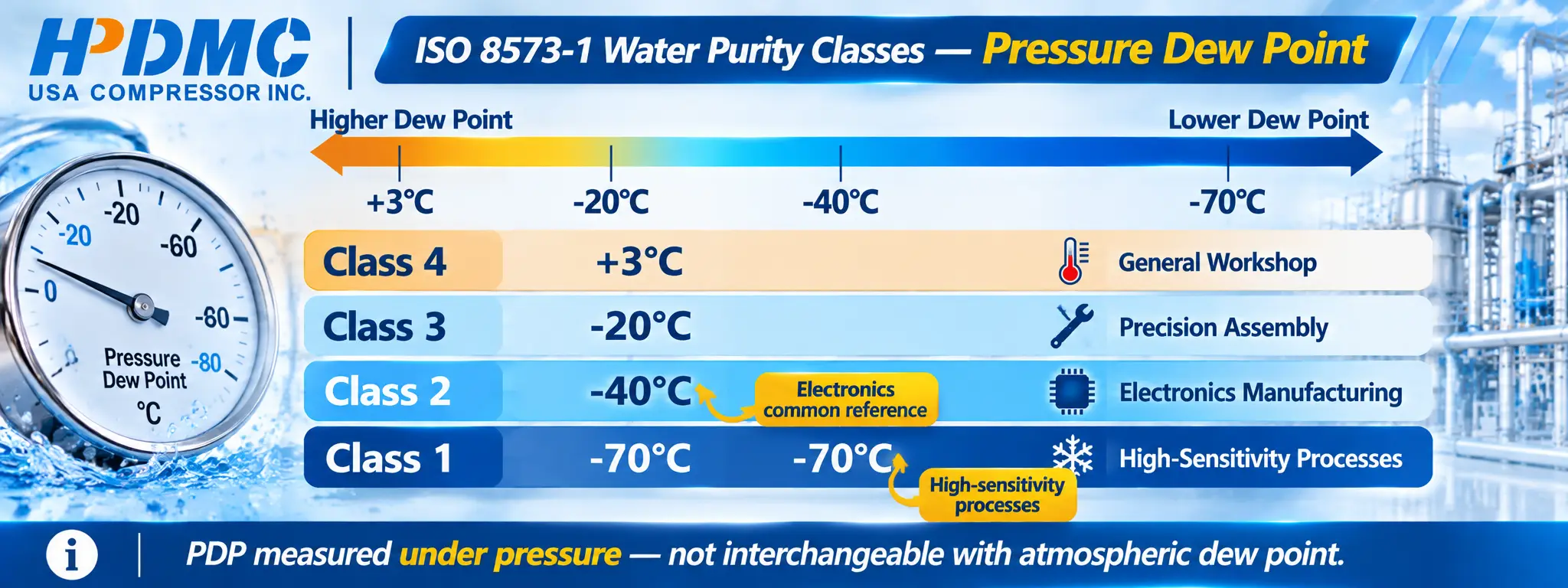
For electronics facilities requiring very dry compressed air, Class 2 (-40°C PDP) is a common specification to evaluate.
Class 1 (-70°C PDP) may be appropriate for applications with more demanding moisture-control requirements.
💡 The final requirement should be determined by the equipment manufacturer, process sensitivity, environmental conditions, and the location of the air-quality measurement point.
Pressure dew point is measured while the air remains under pressure.
It is not interchangeable with atmospheric dew point.
📌 For example, a -40°C pressure dew point measured in a compressed-air line at operating pressure does not mean the same thing as a -40°C dew point measured after the air has been expanded to atmospheric pressure.
This distinction matters when specifying dryers, selecting dew-point sensors, and reviewing supplier test reports.
✅ Always state the measurement pressure and measurement location in the technical specification.
Oil and water are not the only contaminants that matter.
Solid particles can enter a compressed-air system through the intake air, piping, compressor components, or distribution network.
ISO 8573-1 also classifies solid particle concentration by particle size.
For sensitive electronics processes, engineers may evaluate a particle Class 1 requirement, but the final target should reflect the actual process and equipment specifications.
⚠️ Filtration must also be designed for the point of use. A central filter does not guarantee that air remains particle-free after traveling through aging pipes, fittings, and local distribution components.
A standard refrigerated air dryer generally provides a pressure dew point around +3°C under its rated operating conditions.
It is not designed to independently achieve a -40°C pressure dew point.
To reach lower dew points, facilities commonly use a desiccant dryer, either as a standalone system or in combination with a refrigerated dryer used for precooling.
The exact arrangement depends on airflow, ambient conditions, inlet temperature, operating pressure, and energy requirements.
⚠️ One important cost is desiccant dryer regeneration.
Heatless desiccant dryers use a portion of the compressed air to regenerate the desiccant material. This purge air is real airflow demand, not a theoretical allowance.
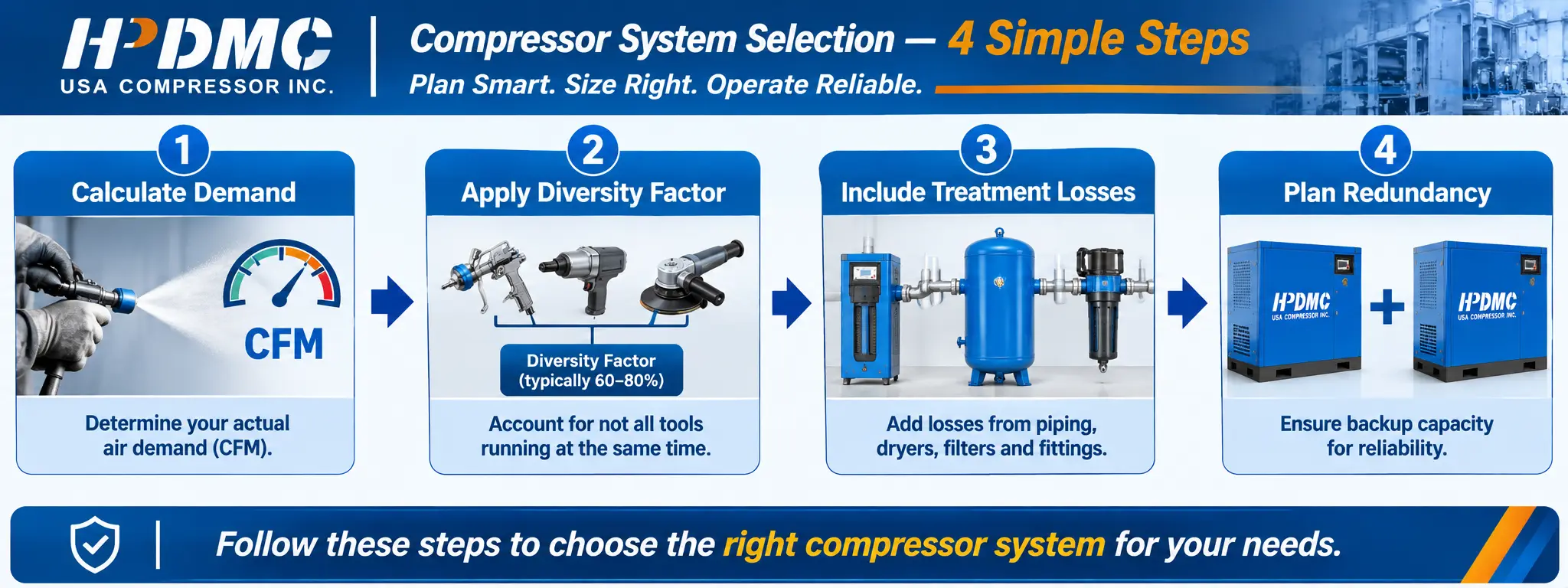
💡 When sizing the compressor, include the dryer manufacturer's regeneration consumption and other treatment-system losses in the total CFM calculation.
Once air purity and moisture requirements have been defined, the next decision is compressor technology.
For electronics facilities, oil-free scroll and oil-free rotary screw compressors are two important options to evaluate.
The correct choice depends on airflow demand, production schedule, operating hours, redundancy requirements, and available installation space.
Oil-free scroll compressors are well suited to applications requiring clean compressed air, relatively stable delivery, and low operating noise.
They are worth considering for:
✔ Laboratory and testing equipment
✔ Instrument air
✔ Small electronics assembly units
✔ Cleanroom support systems
✔ Dedicated production cells
✔ Smaller facilities with moderate compressed-air demand
Scroll technology compresses air through the interaction of fixed and orbiting scroll elements.
Its oil-free compression design avoids introducing lubricating oil into the compression chamber.
For suitable applications, this can simplify oil-contamination control and reduce routine oil-related maintenance.
HPDMC offers oil-free scroll compressor products in configurations ranging from 2 HP to 30 HP, with product listings showing different airflow capacities and configurations.
📖 Explore the HPDMC oil-free air compressor range to compare available equipment.
When an electronics plant operates multiple production lines from a common compressed-air header, its airflow requirements may be significantly higher.
In these cases, an appropriately sized oil-free rotary screw compressor may be worth evaluating.
Potential applications include:
✔ Multi-line SMT production facilities
✔ Larger electronics assembly plants
✔ Centralized compressed-air systems
✔ Facilities operating multiple shifts
✔ Production environments with high and relatively continuous demand
Variable-speed drive (VSD) technology can be particularly valuable in systems with fluctuating demand.
Electronics production rarely operates at exactly the same compressed-air load every minute of the day. Equipment may switch between production, standby, changeover, and maintenance modes.
A properly selected VSD compressor can adjust its output to better match changing demand, potentially reducing unnecessary unloaded operation.
💡 However, VSD should not automatically be treated as mandatory. Engineers should evaluate the actual load profile, compressor turndown range, control strategy, motor efficiency, and total system economics.
For larger systems, a properly designed combination of base-load and trim compressors may provide a better result than relying on one machine.
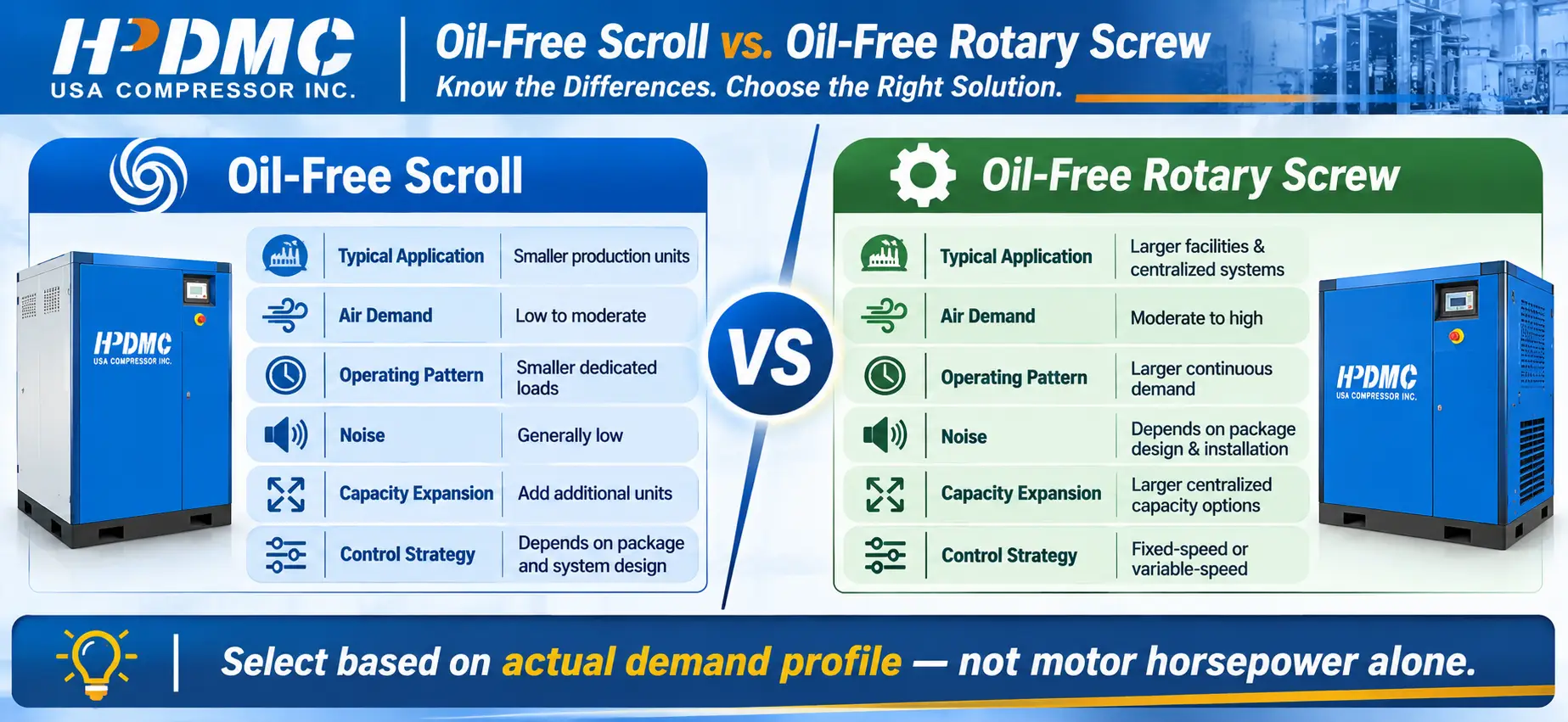
💡 The compressor should be selected based on the actual demand profile, not simply the total installed motor horsepower.
📖 For a broader explanation of scroll technology and its differences from screw compressors, see HPDMC's guide to scroll compressors and their industrial applications.
A reliable electronics compressed-air system needs more than a compressor.
It requires the right compressor technology, drying equipment, filtration, distribution piping, monitoring, and maintenance planning.
HPDMC offers several equipment categories that can support different parts of this system.
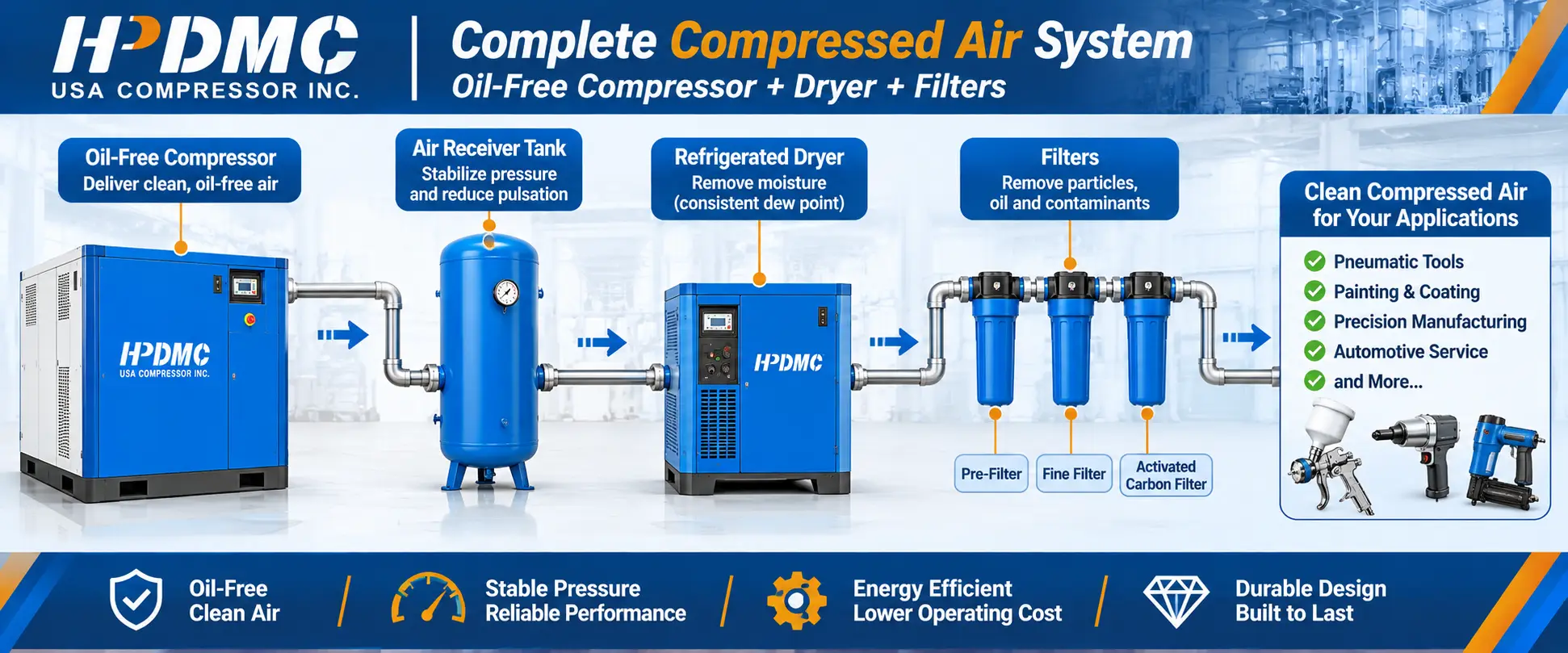
For smaller production areas, laboratories, and dedicated equipment cells, an oil-free scroll compressor may provide an appropriate starting point.
HPDMC's oil-free compressor range includes scroll compressor products from 2 HP to 30 HP, with listed capacity options depending on the model.
For an electronics plant, the engineering team should review:
📖 Start by exploring HPDMC oil-free compressor products.
Not every electronics facility has the same production load.
A laboratory, a single SMT line, and a multi-cell assembly area may require different combinations of compressor capacity, receiver volume, and control arrangements.
📖 HPDMC's oil-free scroll compressor solutions provide a starting point for discussing application-specific configurations.
When requesting a configuration, provide:
An oil-free compressor does not automatically produce air that meets every water and particle purity requirement.
The air-treatment system must be selected separately.
Depending on the required pressure dew point, a system may need:
📖 Explore HPDMC air dryers for compressed-air systems to review available refrigerated and desiccant dryer options.
For electronics manufacturers, equipment delivery can be a production-planning issue.
HPDMC currently advertises inventory in U.S. warehouses in California, Illinois, and New York, with a stated shipping window of 3–10 business days.
This can be useful when evaluating available standard equipment and replacement solutions.
⚠️ However, actual delivery timing depends on the selected model, inventory status, configuration, and shipping destination. Custom-built systems may require additional lead time.
💡 For a planned production-line installation, confirm stock and delivery timing with HPDMC before scheduling commissioning.
Choosing compressor capacity by adding every machine's nameplate airflow is usually not the right approach.
Not all production equipment consumes its maximum rated airflow simultaneously.
A better approach is to build an air-demand profile based on actual equipment operation.
It may be technically possible for some non-critical applications if the complete treatment system is properly engineered and verified.
However, for processes where oil contamination can affect surface preparation, coating, or product quality, an oil-free compressor is a better starting point because it reduces oil contamination risk at the source.
⚠️ The final air quality must still be verified at the required measurement points.
There is no single dew-point requirement for every SMT facility.
A pressure dew point of -40°C (ISO 8573-1 water Class 2) is a useful specification to evaluate for applications requiring very dry compressed air.
Some applications may need less stringent drying, while particularly sensitive processes may require -70°C (Class 1).
✅ Always confirm the requirement with the SMT equipment manufacturer and the process engineering team.
No.
Oil-free compression reduces the risk of oil contamination from the compression process, but the air may still contain water vapor, solid particles, and contaminants introduced by the intake or distribution system.
💡 A complete compressed-air system may require appropriate filtration, moisture separation, refrigerated or desiccant drying, point-of-use treatment, and air-quality testing.
Selecting an air compressor for electronics manufacturing requires more than choosing an oil-free model.
Engineers should define the required oil, particle, and water purity classes; establish the pressure dew point; calculate realistic simultaneous airflow demand; and select compressor technology based on the production load profile.
💡 The most important principle is to specify the complete compressed-air system, not just the compressor.
Quiet, clean, 100% oil-free scroll compressors for medical, food, lab, and electronics applications. Custom configurations from 2 to 30 HP.
👉 Configure Your Scroll Compressor
1-Year Warranty
Easy Returns

US-Based Support
Lifetime Technical Support

Help & Advice
service@sales.hpdmc-compressor.com

Live Help
(888)598-0133



Find the Right Compressor for Your Needs
Find the Right Compressor for Your Needs