How to Choose the Right Pneumatic Air Compressor for Your Workshop in 2026
Summary
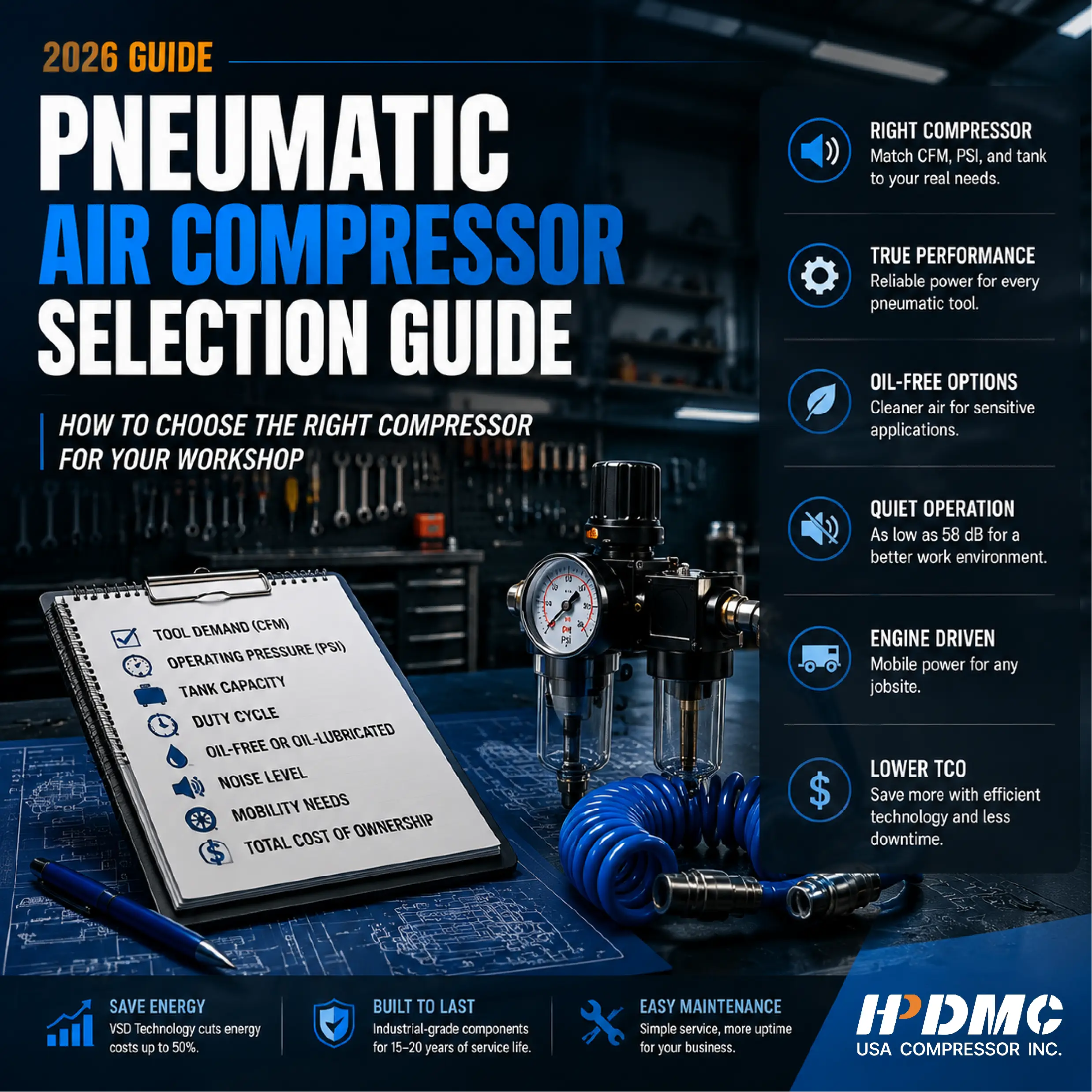
A pneumatic air compressor is the quiet workhorse behind thousands of modern workshops, fabrication bays, automotive service centers, and light industrial lines. Choosing the right unit used to be simple: pick the biggest tank you could afford. In 2026 the decision is more nuanced. Variable speed drive technology, oil-free compression chambers, ultra quiet cabinets, and a growing catalog of engine driven mobile models have reshaped what buyers should evaluate. This guide from HPDMC walks you through the specifications, application matching, and product selection process so you can match a pneumatic air compressor to your real operating profile.
1. What Makes a Pneumatic Air Compressor Different from Other Compressor Types
The term pneumatic air compressor refers to a compressor whose primary output is compressed air used to power pneumatic tools, actuators, conveying systems, and control circuits. The output medium is air, the end use is mechanical work, and every specification is engineered around the behavior of pneumatic tools downstream.
A pneumatic tool is a high flow, intermittent demand device. A half inch impact wrench pulls 4 to 6 CFM at 90 PSI. A framing nailer pulls 2 to 3 CFM but cycles every few seconds. A sander may run continuously at 6 to 8 CFM. None of these tools wants a slow, continuous supply — they want a tank that buffers short bursts of high demand and a pump that refills quickly between cycles. A process gas compressor delivers a continuous, precisely metered gas flow for chemical or medical use. The two machines share physics but not design priorities.
Inside the pneumatic category, three architectures dominate in 2026. Reciprocating piston compressors remain the most common, simple to repair, and well suited to intermittent workshop duty. Rotary screw compressors use two intermeshing rotors to deliver pulse free compressed air and dominate industrial applications where the compressor runs more than four hours per day. Scroll compressors are emerging in the ultra quiet oil free segment, popular for indoor workshops and food adjacent applications. HPDMC manufactures all three architectures under the 📊product overview so buyers can compare side by side.
2. Matching Pneumatic Air Compressor Specifications to Your Application
The four numbers every buyer must understand are CFM, PSI, tank size, and duty cycle. CFM measures the volume of compressed air the pump delivers at a given pressure. PSI is the operating pressure. Tank size is the buffer between pump output and tool demand. Duty cycle is the percentage of time the compressor can run without overheating.
Start with the highest CFM tool in your shop, then add 30 percent headroom. If your largest tool needs 8 CFM at 90 PSI, you want a pump rated for at least 10 to 11 CFM at that pressure. Buying a pump that exactly matches peak demand leaves you short because valves, leaks, and altitude reduce output by 5 to 15 percent. HPDMC's 📄industrial compressor collection catalogs CFM and PSI ratings for every model so you can match the pump to the tool list.
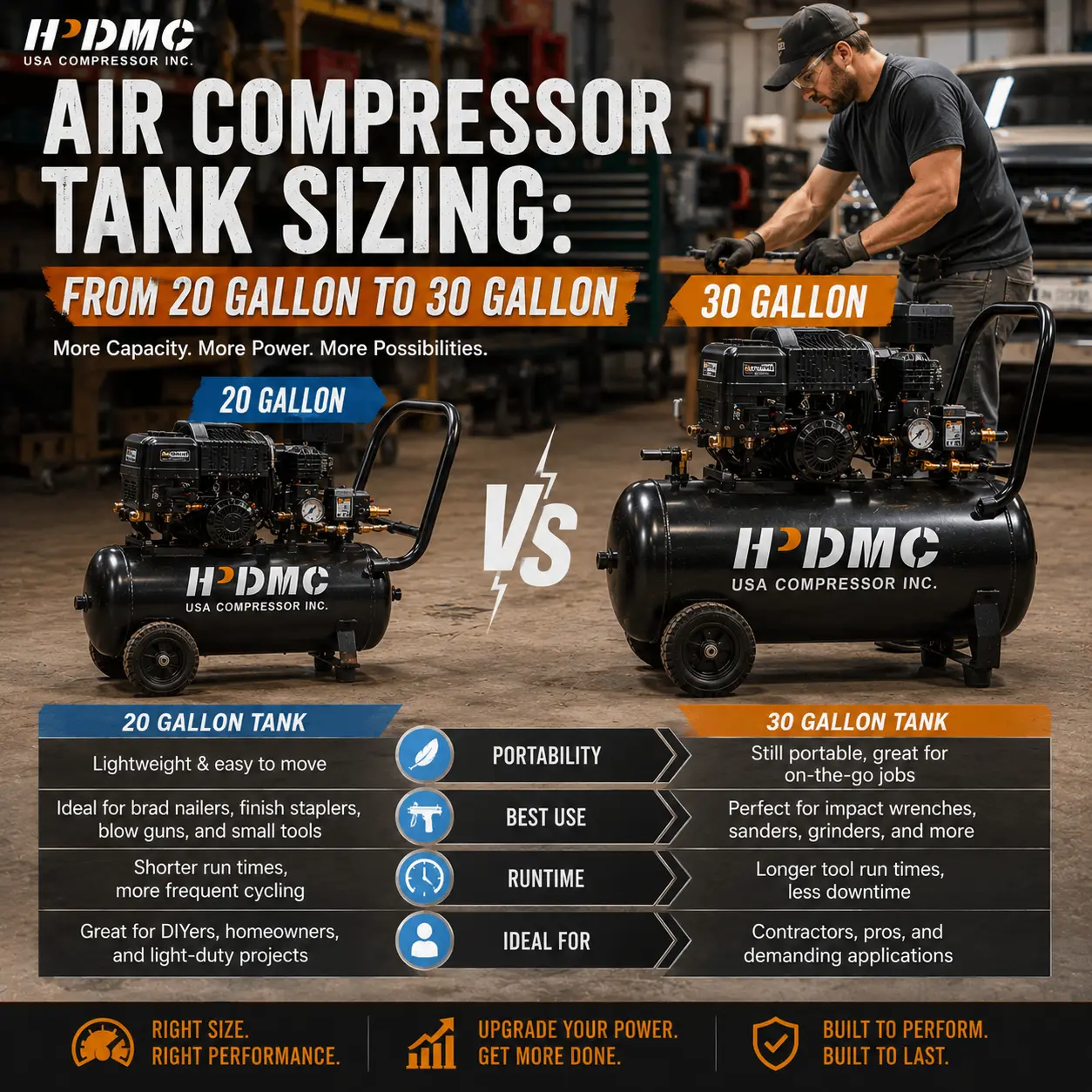
Tank size depends on duty cycle more than CFM. A 6 gallon tank on a 6 CFM pump refills in one minute and supports short bursts of nailer work. A 30 gallon tank on the same pump refills in five minutes but powers a sander through a full cycle without the pump cycling on. The general rule: tank size in gallons should be at least one third of the pump CFM rating. Our guide on 📦air compressor tank sizing from 20 to 30 gallon walks through the math for that case.
Duty cycle separates workshop compressors from industrial compressors. A typical reciprocating piston compressor is rated for 50 to 60 percent duty cycle, or 30 to 36 minutes of run time per hour. This is fine for a two bay automotive shop. It is not fine for a production line that runs the compressor eight hours straight. For continuous duty, a rotary screw compressor is the correct choice. Rotary screw units are rated for 100 percent duty cycle, run cooler, and produce less vibration. The total cost of ownership over 10,000 hours is often lower because rotary screws do not need pistons and rings replaced every 2,000 hours.
3. HPDMC Pneumatic Air Compressor Solutions for Every Workshop
HPDMC organizes its pneumatic air compressor line into three collections that map directly to the three most common buyer profiles. Each collection solves a different problem, and understanding which problem you are actually solving prevents overspending on the wrong architecture.
📌Ultra Quiet Oil Free Compressors for Indoor Workshops
Indoor workshops, basements, garages, and dental labs where noise and oil contamination are deal breakers need an oil free pneumatic air compressor. HPDMC's quiet oil free compressor collection delivers sound levels as low as 58 decibels, comparable to a normal conversation, by combining an oil free compression chamber with a sound dampening cabinet. The flagship model, the AWR800-18LM2 ultra quiet portable oil free air compressor, is a 1.5 HP unit producing 4.2 CFM at 90 PSI in a portable form factor ideal for small workshops and detail work. See the AWR800-18LM2 product page for full specifications.
The oil free designation is more than a marketing label. In a piston compressor the crankcase is filled with oil that lubricates the bearings and cylinder walls, and a small amount migrates into the compression chamber and downstream air. For most pneumatic tools this carryover is harmless. For paint spraying, powder coating, food packaging, dental work, and pharmaceutical applications any oil in the air ruins the finish, contaminates the product, or violates the process requirement. The trade-off is shorter seal life and lower maximum pressure, so oil free compressors are typically rated for 100 to 150 PSI maximum and need seal replacement every 3,000 to 5,000 hours rather than the 8,000+ hours of an oil lubricated equivalent.
📌Industrial Rotary Screw Compressors for Continuous Duty
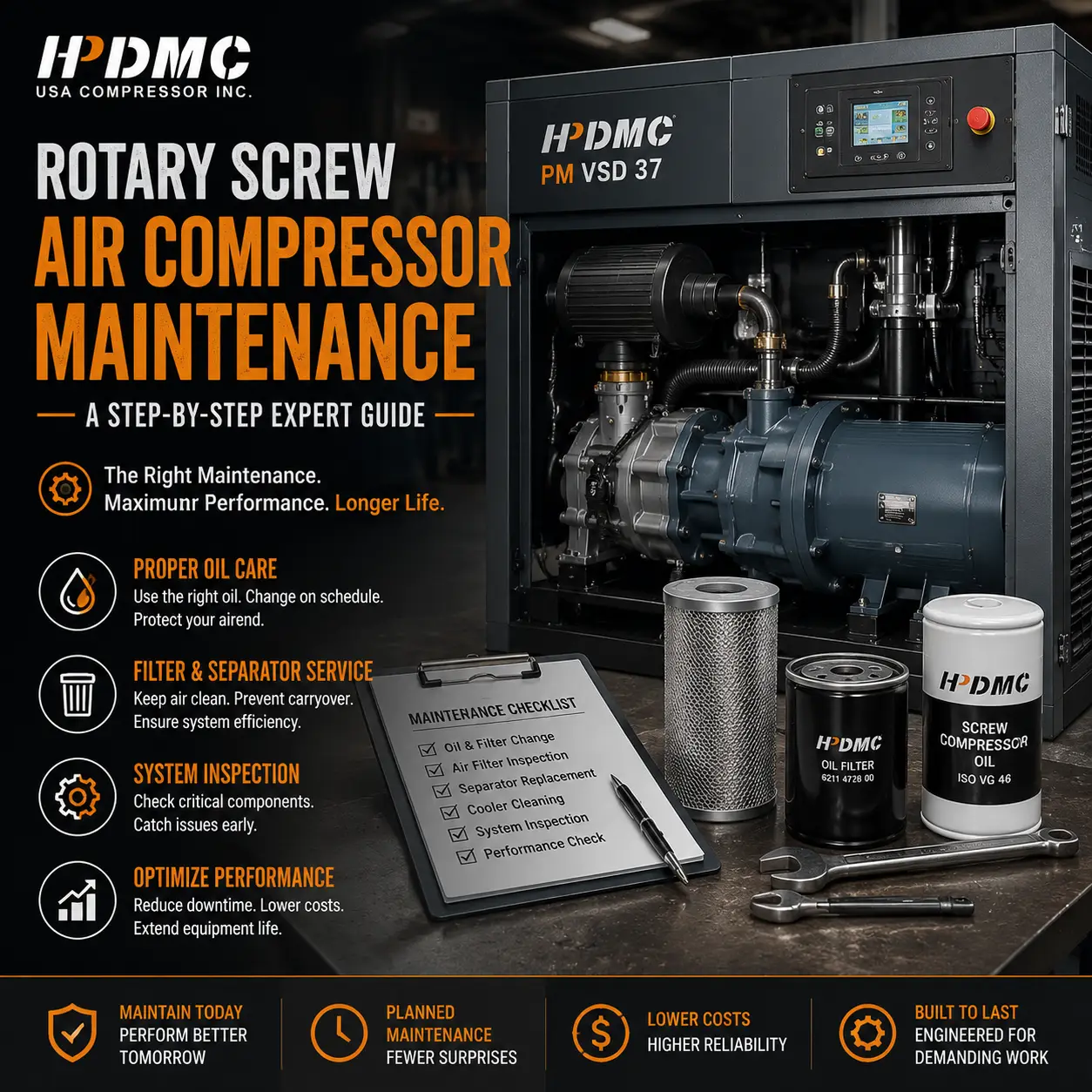
Production lines, machine shops, multi bay tire shops, and any operation that runs a pneumatic air compressor more than four hours per day need a rotary screw unit. HPDMC's industrial compressor collection includes PM VSD rotary screw models from 5.5 HP to 100 HP. VSD technology matches motor speed to air demand in real time, reducing energy consumption by 30 to 50 percent compared to a fixed speed unit. For a buyer running 8 hours per day, the energy savings alone pay back the VSD premium within 18 to 36 months.
Rotary screw compressors also handle the maintenance burden more gracefully than reciprocating units. The airend is engineered for 20,000 to 40,000 hours of life with proper oil and separator changes. Reciprocating compressors need valve and ring service every 1,000 to 2,000 hours. For a buyer comparing lifecycle cost, a rotary screw is the right answer once annual run time exceeds roughly 2,000 hours.
📌Engine Driven Compressors for Jobsite Mobility
Construction sites, agricultural operations, utility crews, and any application where electrical power is unavailable need an engine driven air compressor. These units integrate a gasoline or diesel engine with a reciprocating or rotary screw compressor on a single skid or trailer, producing compressed air in remote locations without grid power. HPDMC's engine driven line includes both portable tow behind units and skid mounted units for truck bed installation. The critical specification for an engine driven unit is CFM per gallon of fuel, not just peak CFM. A poorly matched engine and compressor combination burns 30 to 40 percent more fuel than a properly matched one for the same delivered air, directly determining the cost per job and the frequency of refueling stops on a remote site.
4. Maintenance Essentials for Long Term Pneumatic Air Compressor Reliability
A pneumatic air compressor is one of the longest life equipment purchases in any shop, but only if maintained on a schedule that matches its operating environment. The two failure modes that kill compressors prematurely are neglected filtration and ignored cooling, both addressable in minutes per week with the right habit.
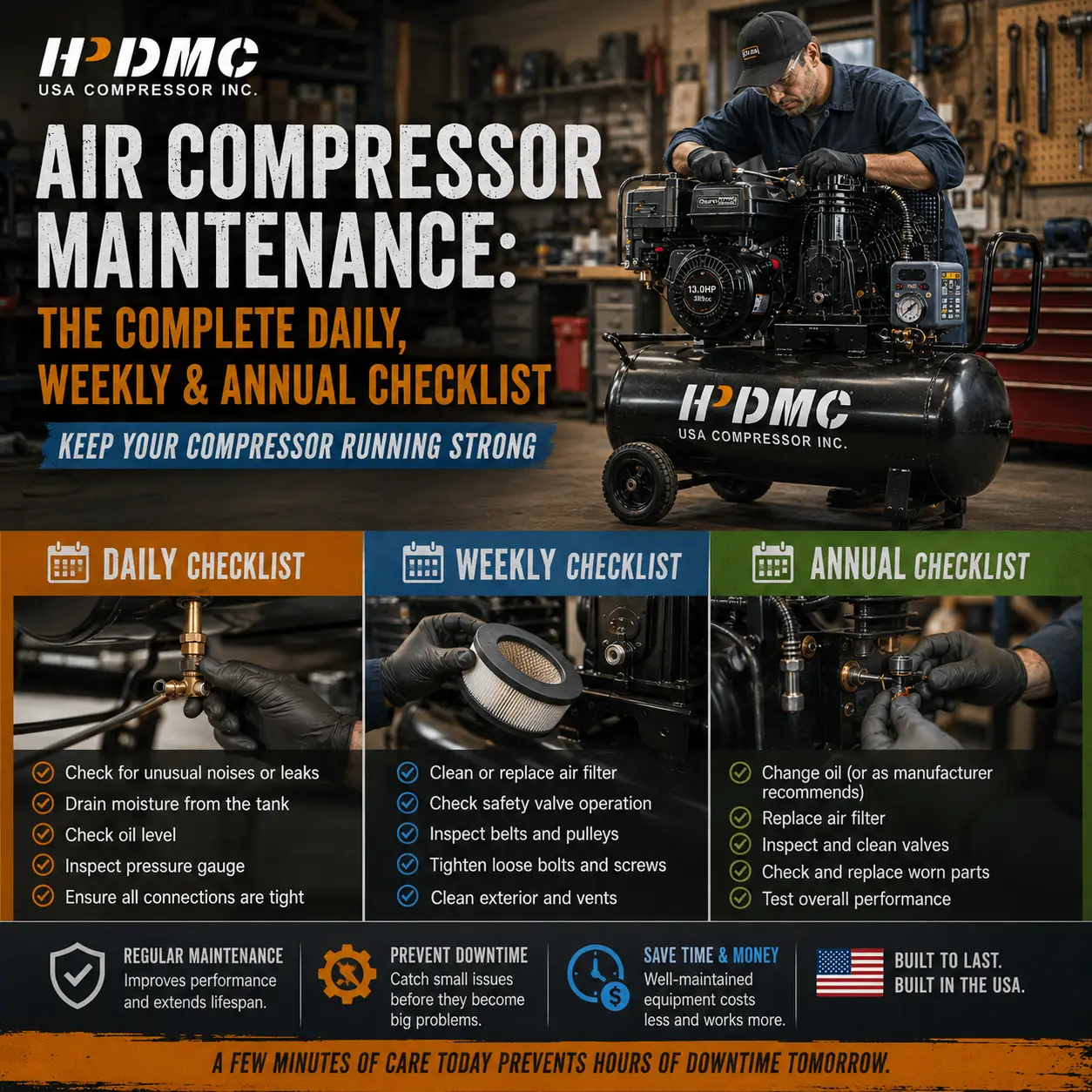
Filtration breaks down into inlet filtration, oil filtration on oil lubricated models, and downstream air filtration. The inlet filter keeps dust out of the compression chamber. On a dusty jobsite it needs inspection weekly and replacement monthly. In a clean indoor shop it can go 500 hours between changes. Skipping inlet filter changes pulls abrasive dust into the cylinder, scoring the walls and shortening piston ring life by 70 to 80 percent. 📰HPDMC's 📦air compressor preventive maintenance guide catalogs the exact filter change intervals for each duty cycle tier.
Cooling is the second most common failure path. Reciprocating compressors reject heat through finned cylinder heads and an external fan. Rotary screw compressors reject heat through an oil cooler. In both cases, dust on the cooling surfaces blocks airflow, running temperature climbs, oil breaks down faster, and seals fail prematurely. The fix is straightforward: blow compressed air through the cooling fins monthly, keep the compressor at least 18 inches from any wall, and verify intake air is below 105 degrees Fahrenheit. These three steps prevent the majority of premature failures in field deployed units.
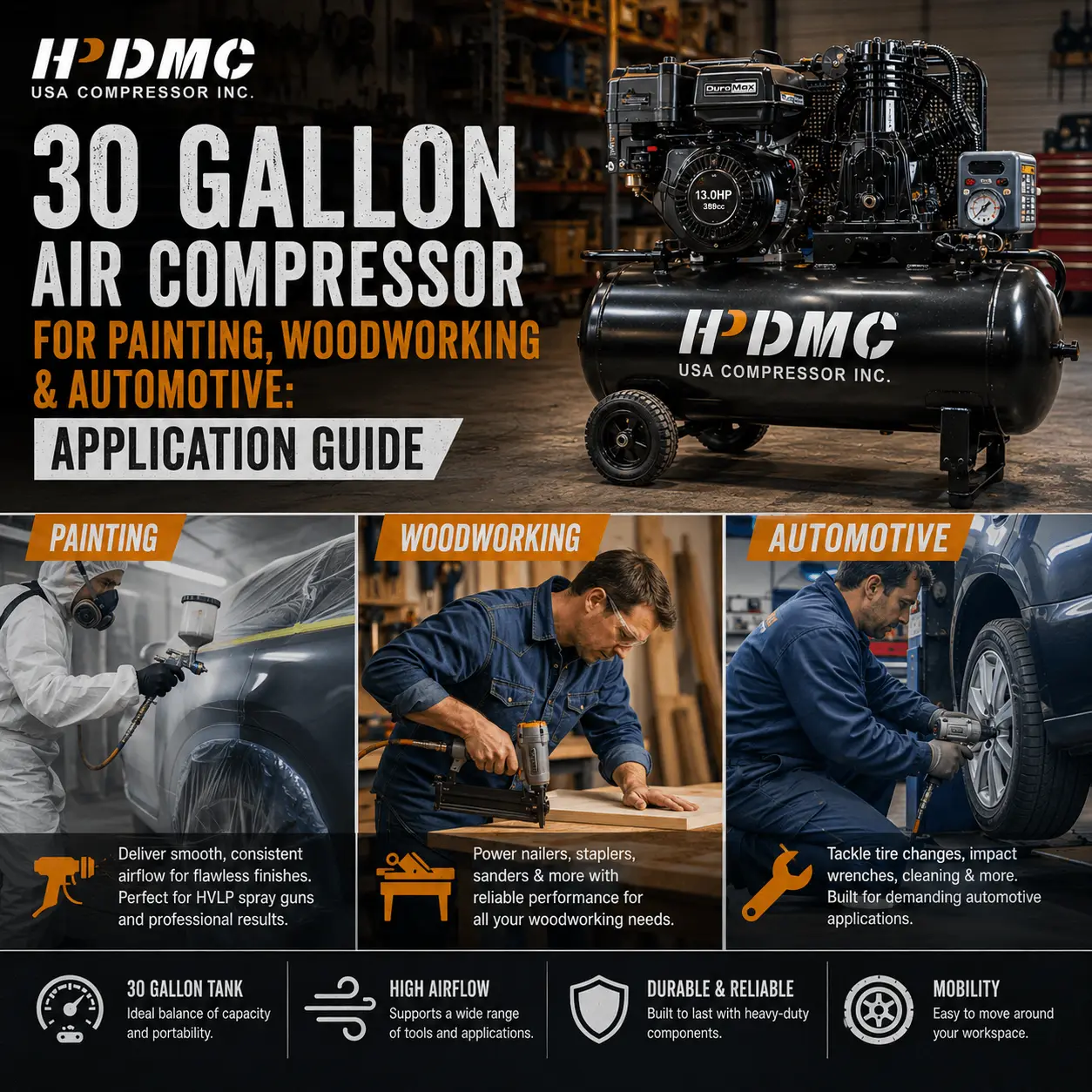
For buyers who want to understand the long-term ownership experience, our 📰30 gallon air compressor for painting, woodworking, and automotive guide provides a 12 month ownership case study of a typical 30 gallon reciprocating unit.
5. Build Your Workshop Around the Right Pneumatic Air Compressor
The right pneumatic air compressor is the one that matches your real demand profile. For an indoor workshop, an oil free quiet unit like the AWR800-18LM2 keeps noise and contamination out of the work environment. For a multi bay production shop, a VSD rotary screw reduces energy cost and delivers continuous duty performance. For a remote jobsite, an engine driven unit frees you from the grid entirely. HPDMC supports all three paths through a single🛒 product catalog backed by 🌍company-wide technical support, a one year warranty, and a U.S. based service team.
To compare models, request a quote, or get a sizing consultation, visit the 🏠HPDMC home page or contact the technical support team directly. The right compressor is the one you will not think about for the next decade, and the wrong one will be the equipment failure you cannot forget.
6. Frequently Asked Questions About Pneumatic Air Compressors
What size pneumatic air compressor do I need for a small workshop?
For a small workshop running one or two pneumatic tools intermittently, a 20 to 30 gallon tank with a 5 to 7 CFM pump at 90 PSI is the most common configuration. This pairing supports a framing nailer, finish nailer, brad nailer, and a small impact wrench without the pump running continuously. For a sander or spray gun run for extended sessions, step up to a 30 to 60 gallon tank to add buffer capacity. The HPDMC air compressor tank sizing guide walks through the calculation for matching tank size to your tool mix.
Is an oil free pneumatic air compressor better than an oil lubricated one?
Neither is universally better — they serve different purposes. An oil free compressor delivers cleaner air, runs quieter, and requires less routine maintenance because there is no crankcase oil. It is the correct choice for paint spraying, food adjacent work, dental and medical applications, and any indoor environment where oil mist is unacceptable. An oil lubricated compressor runs cooler, lasts longer under heavy duty, and reaches higher maximum pressure, making it the correct choice for industrial and high CFM applications.
Can a pneumatic air compressor run continuously?
Standard reciprocating piston compressors are rated for 50 to 60 percent duty cycle, which is 5 to 6 minutes of run time per 10 minute window. Running them continuously overheats the motor, scores the cylinder walls, and causes premature seal failure. If your application requires continuous duty, step up to a rotary screw compressor, which is rated for 100 percent duty cycle and engineered for continuous operation at elevated temperatures. HPDMC's industrial rotary screw line covers the full continuous duty range from 5.5 HP workshop models to 100 HP production line units.
How do I reduce noise from my pneumatic air compressor?
The most effective noise reduction is to buy a quiet unit from the start. HPDMC's ultra quiet oil free compressors operate as low as 58 decibels, comparable to a normal conversation. If you already own a louder compressor, secondary strategies help: mount the unit on rubber isolation pads, install a sound absorbing enclosure around the compressor room, route the intake through a remote silencer, and replace worn bearings. Together these strategies can reduce perceived noise by 6 to 10 decibels.
What is the difference between CFM and PSI in pneumatic air compressor specifications?
CFM is the volume of air the compressor delivers at a specified pressure. PSI is the pressure at which that air is delivered. A compressor rated 7 CFM at 90 PSI can deliver 7 cubic feet of air per minute when system pressure is 90 PSI. The relationship matters because pneumatic tools have a minimum CFM requirement at a specific PSI. Buying a compressor with high CFM at 150 PSI is useless if your tools need 90 PSI and the compressor cannot sustain the required CFM at that lower pressure. Always compare CFM ratings at the PSI your tools actually use, and size for the highest demand tool in your shop, not the average.