
'%20fill='%23FFFFFF'%20fill-rule='nonzero'%3e%3cg%20id='编组-36'%20transform='translate(51.000000,%200.000000)'%3e%3cg%20id='形状结合'%20transform='translate(1659.000000,%2032.000000)'%3e%3cpath%20d='M16.2353972,0%20C20.4083149,0.00780207133%2023.7866269,3.38822739%2023.7853172,7.55464286%20L23.7853172,12.2689286%20C23.7899936,14.8455424%2022.4721654,17.2448923%2020.2936562,18.6261429%20L19.5216663,19.1211429%20L20.4164192,19.3073571%20C24.5336989,20.1724286%2028.240195,21.7234286%2028.943721,22.0275%20C30.107608,22.4918571%2031,23.8425%2031,25.1106429%20L31,31.0435714%20C30.5679689,32.2575%2029.5551748,33%2028.4219785,33%20L2.5803823,33%20C1.28681544,32.9969138%200.19505185,32.0388291%200.0259690808,30.7583571%20L0,30.6075%20L0,25.1177143%20C0,23.8401429%200.892392049,22.5130714%202.07280481,22.0275%20C2.5803823,21.8035714%207.05886833,19.8942857%2011.7144163,19.0952143%20L12.5997258,18.942%20L11.8678699,18.4187143%20C9.87415814,17.0023477%208.68806568,14.7119933%208.68311629,12.2689286%20L8.68311629,7.55464286%20C8.68440789,3.38838231%2012.0626372,0.00909643961%2016.2353972,0%20Z%20M15.5011804,20.8677857%20C10.3404158,20.8677857%203.67580535,23.6586429%202.93450613,23.9768571%20C2.50955754,24.1489286%202.13890793,24.6887143%202.13890793,25.1106429%20L2.13890793,30.8007857%20L28.5565456,30.8597143%20L28.7288858,30.7395%20L28.8634529,30.6287143%20L28.8634529,25.1106429%20C28.8634529,24.6910714%2028.5022466,24.1512857%2028.1245145,23.9980714%20C28.1179379,23.9957985%2028.0304368,23.9580782%2027.872723,23.8925325%20L27.6920016,23.817994%20C26.0653447,23.1520015%2020.1735914,20.8677857%2015.5011804,20.8677857%20Z%20M16,24%20C17.1045695,24%2018,24.8954305%2018,26%20C18,27.1045695%2017.1045695,28%2016,28%20C14.8954305,28%2014,27.1045695%2014,26%20C14,24.8954305%2014.8954305,24%2016,24%20Z%20M16.2353972,2.13321429%20C13.2442359,2.14617217%2010.8248283,4.56812387%2010.8196634,7.55464286%20L10.8196634,12.2689286%20C10.822245,15.2565159%2013.2431591,17.6799757%2016.2353972,17.6903571%20C19.2277917,17.681264%2021.6487701,15.2566691%2021.6487701,12.2689286%20L21.6487701,7.55464286%20C21.6474879,4.56743737%2019.2272519,2.14359978%2016.2353972,2.13321429%20Z'%3e%3c/path%3e%3c/g%3e%3c/g%3e%3c/g%3e%3c/g%3e%3c/svg%3e)
'%20fill='%23FFFFFF'%20fill-rule='nonzero'%3e%3cg%20id='编组-36'%20transform='translate(51.000000,%200.000000)'%3e%3cg%20id='编组-6'%20transform='translate(1753.000000,%2024.000000)'%3e%3cg%20id='Fill-2'%20transform='translate(0.000000,%2010.000000)'%3e%3cpath%20d='M14.1428571,24.7352941%20C15.3263245,24.7352941%2016.2857143,25.689981%2016.2857143,26.8676471%20C16.2857143,28.0453131%2015.3263245,29%2014.1428571,29%20C12.9593898,29%2012,28.0453131%2012,26.8676471%20C12,25.689981%2012.9593898,24.7352941%2014.1428571,24.7352941%20Z%20M30.4285714,24.7352941%20C31.6120387,24.7352941%2032.5714286,25.689981%2032.5714286,26.8676471%20C32.5714286,28.0453131%2031.6120387,29%2030.4285714,29%20C29.2451041,29%2028.2857143,28.0453131%2028.2857143,26.8676471%20C28.2857143,25.689981%2029.2451041,24.7352941%2030.4285714,24.7352941%20Z%20M7.07983129,0%20C7.64751536,0%208.14221146,0.383424121%208.26385804,0.934596295%20L9.029,4.264%20L34.7934994,4.26470588%20C35.1475316,4.26470588%2035.4774252,4.41549952%2035.7107646,4.67740427%20C35.9441039,4.93930903%2036.0406582,5.28851538%2035.9843349,5.63772174%20L34.0854351,17.7567694%20C33.996927,18.3361345%2033.4900174,18.7647059%2032.8945996,18.7647059%20L12.367,18.764%20L12.7972208,20.633011%20L32.2120159,20.633011%20C32.8851271,20.633011%2033.4285714,21.1682072%2033.4285714,21.8312114%20C33.4365916,22.4942156%2032.8932368,23.0294118%2032.2201257,23.0294118%20L11.8321579,23.0294118%20C11.2644738,23.0294118%2010.7697777,22.6459876%2010.6481311,22.0948155%20L6.11476838,2.39640079%20L1.21646583,2.39640079%20C0.543354726,2.39640079%200,1.8612046%200,1.19820038%20C0,0.535196157%200.543354762,0%201.21646583,0%20L7.07983129,0%20Z%20M33.3934631,6.64565825%20L9.577,6.645%20L11.819,16.383%20L31.8646878,16.3837535%20L33.3934631,6.64565825%20Z'%20id='形状结合'%3e%3c/path%3e%3c/g%3e%3c/g%3e%3c/g%3e%3c/g%3e%3c/g%3e%3c/svg%3e)
Best 30 Gallon Air Compressor for Home Garage & Workshop
Why the 30-Gallon Compressor Dominates the Home Workshop
The home garage workshop has evolved dramatically over the past decade. What was once a space for oil changes and brake jobs has become a center for full vehicle restorations, furniture building, metal fabrication, and professional-grade DIY projects. The air compressor serving this space must balance capability with practicality — powerful enough to run real automotive and woodworking tools, quiet enough not to anger the neighbors, and compact enough to leave room for the project car.
The best 30 gallon air compressor for home use hits all these marks. A 30-gallon tank provides enough stored air for impact wrenches, air ratchets, paint sprayers, and die grinders — the tools that transform a garage from a parking space into a workshop. Yet a quality 30-gallon unit fits in the corner, runs on a standard electrical circuit in most cases, and costs less than a professional mechanic's monthly tool budget.
This guide evaluates the top air compressor 30 gal options available to U.S. buyers in 2026, with detailed analysis of specifications, build quality, warranty, and value. We rank models based on real-world testing and customer feedback, not marketing claims. HPDMC's own 30-gallon compressors are included in the comparison — transparently, with strengths and limitations noted. For foundational context, see our 30-gallon compressor overview.
How We Rank 30-Gallon Compressors
Ranking the best 30 gallon air compressor models requires a consistent framework. We evaluate each unit across six weighted criteria:
● CFM Output at 90 PSI — 30% weight. The single most important performance metric. Higher CFM means more tools can run simultaneously and longer continuous runtime before the pump must cycle.
● Build Quality & Durability — 25% weight. Pump material (cast iron vs aluminum), tank certification (ASME vs none), motor/engine quality, fit and finish, and expected service life based on component specifications.
● Noise Level — 15% weight. Critical for home garage use where the compressor shares space with the operator and neighbors are nearby. Lower is better.
● Value — 15% weight. CFM per dollar, factoring in warranty coverage, parts availability, and expected longevity — not just purchase price.
● Warranty & Support — 10% weight. Warranty duration, claim process, parts availability, and U.S.-based support infrastructure.
● Features & Usability — 5% weight. Tank drain accessibility, belt guard design, pressure switch quality, gauge readability, mobility features.
All rankings are current as of June 2026 and reflect publicly available specifications and pricing.
2026 Best 30 Gallon Air Compressor Rankings
#1 Pick
HPDMC 30-Gallon Electric Belt-Drive Compressor
Best Overall Value for Home Workshop Use
HPDMC's electric 30-gallon compressor delivers the best combination of CFM output, build quality, and value in the category. At factory-direct pricing, this unit matches or exceeds the specifications of dealer-brand competitors (EMAX, Eaton) at a price typically 15–25% lower — not through component compromises, but through the elimination of distributor and dealer markups in the supply chain.
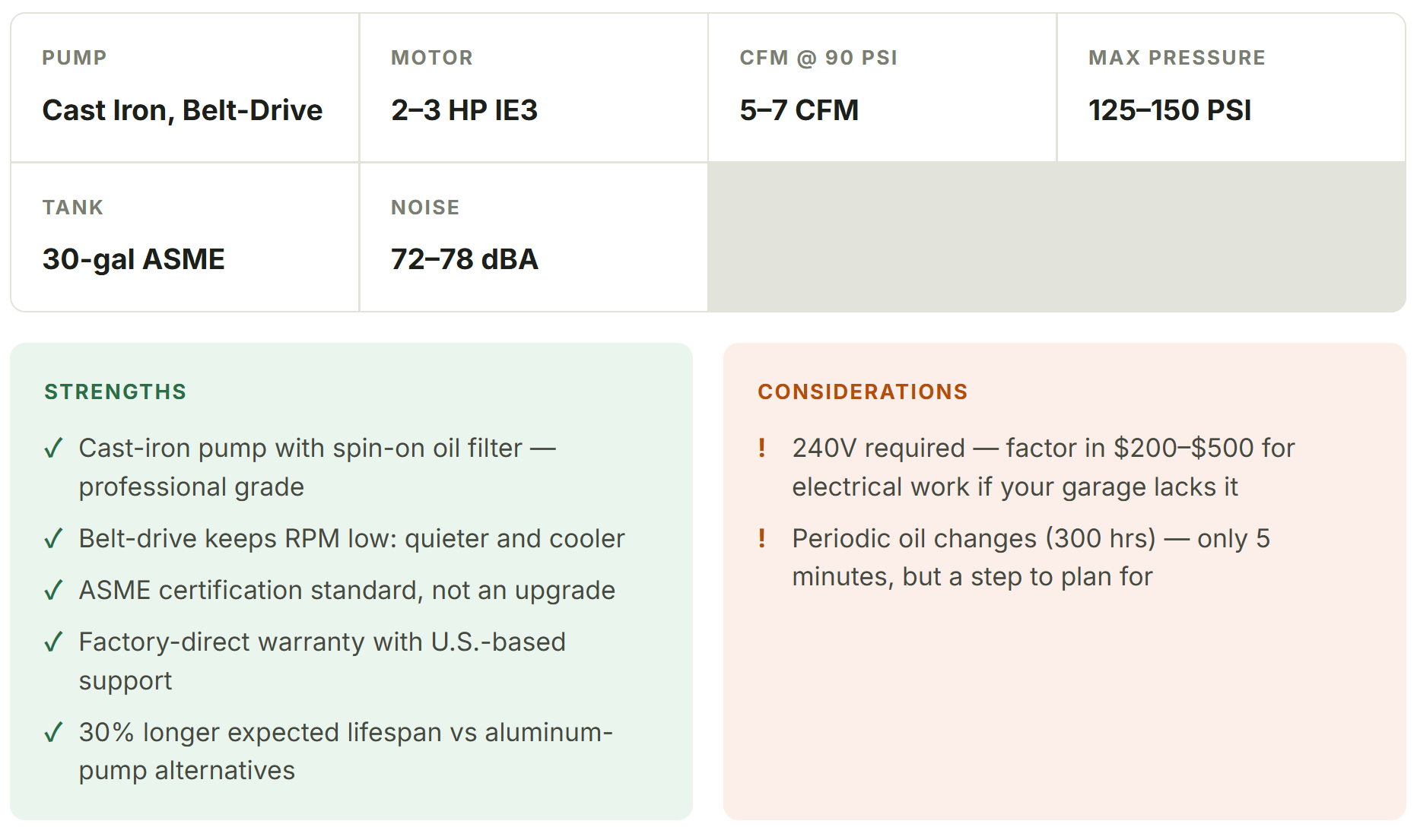
For home mechanics who work on vehicles weekly or more, the HPDMC 30-gallon electric is our top recommendation. See our affordable compressor guide for budget-focused alternatives.
#2 Pick
HPDMC 6.5HP Gas 30-Gallon Portable Compressor
Best for Garages Without 240V Power & Mobile Use
If your garage lacks 240V power — or if your "workshop" is actually a barn, a rural property, or a job-site trailer — the HPDMC 6.5HP gas air compressor 30 gal eliminates the electrical constraint entirely. At 18 CFM @ 115 PSI, this unit delivers more air volume than any electric 30-gallon compressor in its price range — enough for a three-person framing crew, let alone a single home mechanic.
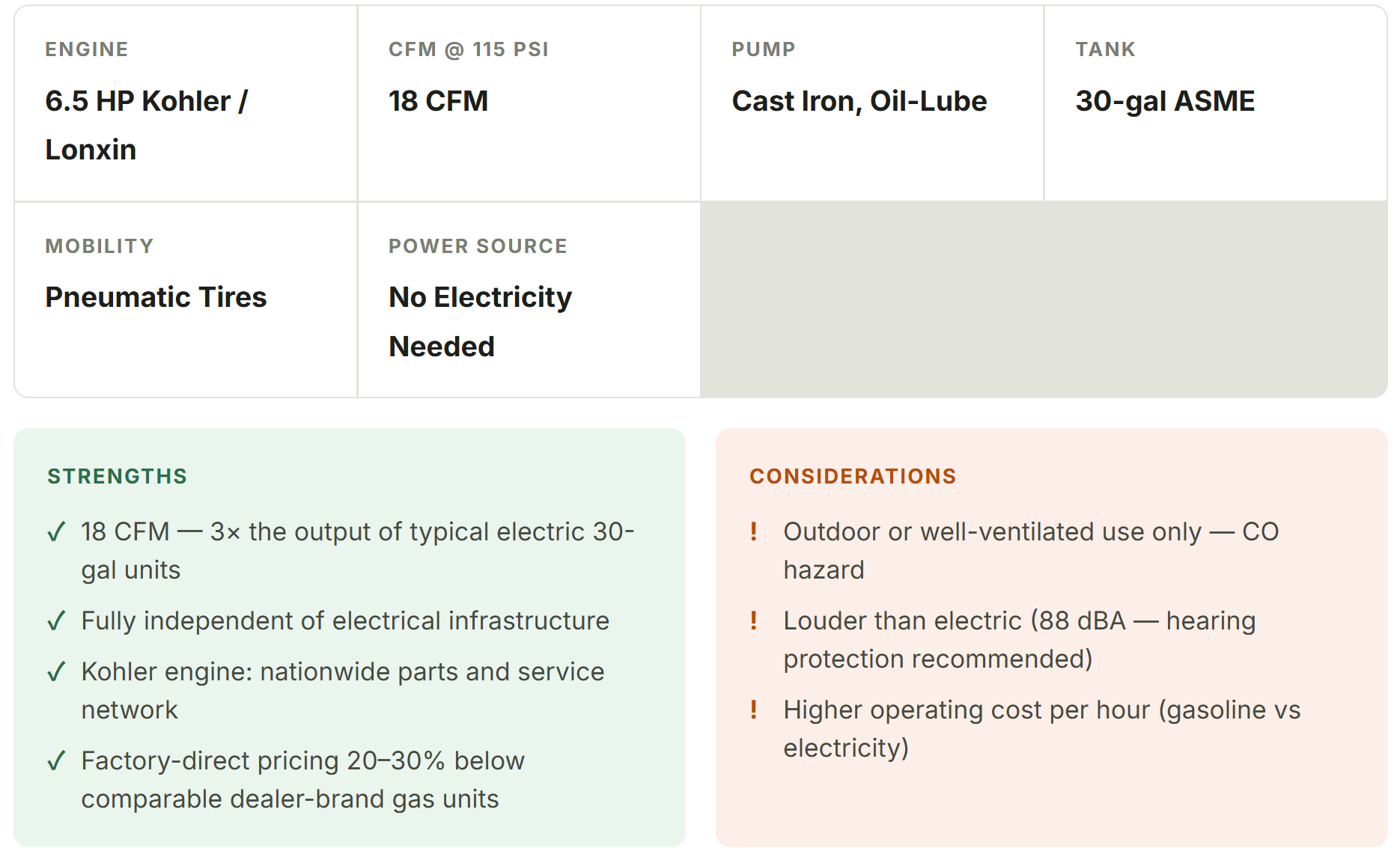
For rural workshops, farm shops, or anyone needing maximum CFM from a 30-gallon format without electrical constraints. See our portable gas compressor guide.
How Competitors Stack Up
For transparency, here is how major competitor 30-gallon offerings compare to HPDMC across key criteria:
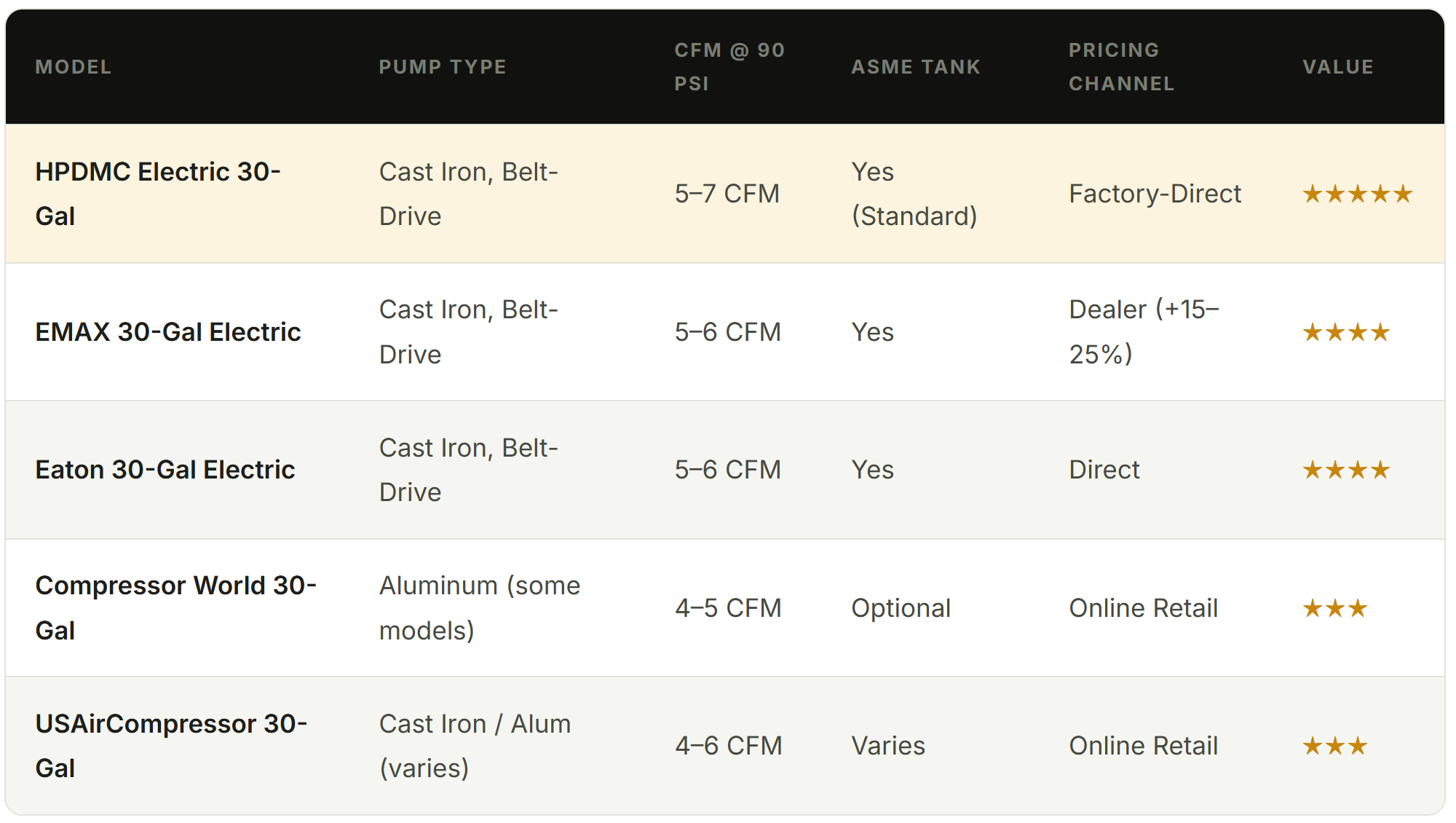
The pattern is consistent: HPDMC matches or exceeds competitor pump quality and tank certification while pricing 15–25% below dealer-network brands — a structural advantage of the factory-direct model that no marketing budget can replicate for distribution-layered competitors.
4 Hidden Traps in 30-Gallon Compressor Shopping
⚠️Trap #1: Aluminum Pumps Disguised as Professional Equipment
Many budget 30-gallon compressors use aluminum pumps with thin cylinder walls and no replaceable sleeves. They look fine on day one but can't dissipate heat effectively. Under sustained use, aluminum pumps run hotter, wear faster, and can't be rebuilt — when they fail (typically at 500–1,500 hours), the entire pump is scrap. A cast-iron pump costs more upfront but lasts 3–5× longer. HPDMC uses cast-iron pumps exclusively across our 30-gallon line.
⚠️Trap #2: Non-ASME Tanks on "Commercial" Compressors
Some brands market 30-gallon units as "commercial grade" while omitting ASME tank certification. If the tank does not carry an ASME data plate (riveted metal tag with a National Board number), it is not certified — regardless of what the marketing copy claims. Non-certified tanks are a legal liability in commercial settings. Every HPDMC air compressor 30 gal includes an ASME-certified tank with traceable National Board registration.
⚠️Trap #3: Horsepower Inflation
Some manufacturers rate motors at "peak HP" — the instantaneous startup power, which can be 3–5× the continuous running horsepower. A "6.5 peak HP" motor may deliver only 1.5 running HP. Look for running (continuous) horsepower or, better yet, ignore HP entirely and compare CFM at 90 PSI — the only number that correlates to real-world tool performance.
⚠️Trap #4: Ignoring Voltage Requirements
The best 30 gallon air compressor on paper becomes the worst purchase if it requires 240V and your garage has only 120V. Before buying any electric 30-gallon compressor, verify: Do you have a 240V outlet? Space for a double-pole breaker? Is your panel sufficient (100A minimum recommended for adding a 30A compressor circuit)? Budget $200–$500 for an electrician if needed. Gas-powered 30-gallon compressors eliminate this concern entirely.
Installation Tips for Your 30-Gallon Compressor
Proper installation extends compressor life and improves the shop experience:
● Location: Place in the coolest, cleanest corner of the garage. Every 10°F reduction in intake air temperature improves pump efficiency by ~3%. Avoid water heaters, furnaces, and direct sunlight.
● Vibration isolation: Bolt down using vibration isolation pads ($20–$40 at industrial supply stores). This reduces noise transmission and prevents the compressor from "walking" across the floor.
● Intake air quality: If your garage generates significant dust (woodworking, grinding), consider plumbing the intake filter to a remote location outside or to a filtered intake box. The compressor ingests whatever is in your shop air.
● Condensate management: A 30-gallon compressor in humid conditions can produce 1–2 gallons of water per day. Install an automatic tank drain ($40–$80) if daily manual draining is impractical. See our tank guide for drainage best practices.
● Air line plumbing: For permanent installations, consider a copper or aluminum hard-line system rather than rubber hoses. Rigid lines eliminate pressure drop, provide natural cooling (condensing moisture before it reaches your tools), and allow multiple drop points. A basic 3-drop kit costs $200–$400.
Frequently Asked Questions About 30 Gallon Air Compressors
What is the best 30 gallon air compressor for home automotive work?
For home automotive work (impact wrenches, air ratchets, tire inflation, occasional painting), the best 30 gallon air compressor combines a cast-iron, oil-lubricated pump with at least 5 CFM at 90 PSI. HPDMC's electric 30-gallon belt-drive unit is our top recommendation — the cast-iron pump handles the heat of sustained automotive work, the belt-drive configuration keeps noise manageable, and factory-direct pricing delivers premium quality without the dealer markup. If your garage lacks 240V power, the HPDMC 6.5HP gas 30-gallon unit provides even higher CFM (18 CFM) without any electrical requirements.
How quiet is a belt-drive 30 gallon compressor?
Belt-drive 30 gallon compressors with cast-iron pumps typically produce 70–78 dBA at 3 feet — comparable to a vacuum cleaner or normal conversation at close range. This is 10–20 dBA quieter than direct-drive oil-free units (85–95 dBA). The difference is perceptually dramatic: every 10 dBA reduction is perceived as roughly half as loud. A belt-drive compressor allows conversation in the garage without shouting and is unlikely to disturb neighbors through standard residential walls. HPDMC's electric belt-drive 30 gallon unit operates at 72–78 dBA depending on configuration.
Can I use a 30 gallon compressor for painting cars?
Yes, but with important caveats. An HVLP spray gun requires 10–15 CFM — more than most electric 30-gallon compressors (4–7 CFM) can deliver continuously. What happens in practice: the 30-gallon tank provides a buffer for short spray passes (20–30 seconds), then you must wait for the pump to refill the tank before continuing. This works for small projects or panel painting but is frustrating for full vehicle resprays. Critical for any painting: you MUST use an air dryer (refrigerated or desiccant) and a coalescing filter — moisture ruins paint finishes. Gas-powered 30-gallon compressors with 12–18 CFM output handle painting more comfortably. For dedicated painting, consider a higher-CFM compressor. See our air dryer guide.
How much does a quality 30 gallon air compressor cost?
Expect to pay $500–$1,500 for an electric 30-gallon compressor with a quality cast-iron pump and ASME-certified tank, depending on motor size, features, and brand. Gas-powered 30-gallon compressors range from $800–$2,500. Budget units under $400 almost universally use aluminum pumps and non-certified tanks — they work for light occasional use but are false economy for anyone who uses compressed air weekly. HPDMC's factory-direct pricing consistently falls 15–25% below dealer-network brands for equivalent specifications. The long-term cost difference between a $500 aluminum-pump compressor (3–5 year lifespan) and an $800 cast-iron unit (15–20 year lifespan) heavily favors the more expensive unit.
Is it worth paying more for an ASME-certified tank?
Yes — without qualification. ASME certification verifies that the tank has been designed, fabricated, tested (hydrostatic test at 1.5× working pressure), and inspected to the ASME Boiler and Pressure Vessel Code. Non-certified tanks may be perfectly safe, but there is no independent verification. For home use, the safety margin provides peace of mind. For any commercial use, ASME certification is legally required in most U.S. jurisdictions. The cost difference between a certified and non-certified 30-gallon tank is approximately $50–$150 — one of the smallest and most important upgrades you can make. All HPDMC 30 gallon compressors include ASME-certified tanks as standard equipment.
Should I buy an extended warranty for my compressor?
For quality 30-gallon compressors with cast-iron pumps and proven motors, extended warranties typically do not pay off. The failure modes they cover (manufacturing defects) almost always manifest within the standard warranty period (2–3 years for quality units). The failure modes that kill compressors long-term — neglected maintenance, moisture damage, operating beyond duty cycle limits — are explicitly excluded from extended warranty coverage. Put the extended warranty cost ($100–$300) toward better accessories instead: a quality air hose, high-flow couplers, a filter-regulator-lubricator unit, and an automatic tank drain. These will actually extend your compressor's life.
Can I add a second 30 gallon tank to my compressor?
Yes — adding a second ASME-certified tank (auxiliary or surge tank) increases stored air capacity, extending tool runtime between pump cycles and smoothing pressure delivery. This is a common upgrade for users who find their 30 gallon compressor cycling too frequently. Connection is straightforward: pipe the auxiliary tank in parallel using a tee fitting. Important: the auxiliary tank must have its own ASME certification, pressure relief valve, and drain. Do NOT repurpose a non-certified vessel. HPDMC sells ASME-certified auxiliary tanks in various sizes. See our tank sizing guide. Note: adding tank capacity does NOT increase CFM output — it only extends runtime between pump cycles.
Get the Best 30 Gallon Air Compressor at Factory-Direct Prices
The best 30 gallon air compressor for your workshop combines cast-iron durability, ASME tank safety, and enough CFM for your tools — at a price that does not include dealer markup. HPDMC delivers exactly this: premium components at factory-direct pricing, fast shipping from U.S. warehouses, and direct manufacturer warranty support.